
Industry Insights
Private Label Shirt Development Costs: Why Small First Orders Cannot Spread the Cost of Custom Fabric, Labels and Packaging
A factory can make the full brief. Start version one on in-stock cloth with logo embroidery; add neck labels, cloth and packaging as volume grows.
Quick answer: A factory can make a private-label shirt with its own fabric, embroidered logo, woven neck label and branded packaging. Each of those items has a fixed setup cost, paid once, whether you order a hundred shirts or a few thousand. On a large run, each shirt carries a thin slice of that setup. On a small first order, the same setup sits heavily on every piece, unless you choose to pay it as a development charge. The honest, practical start is to use the factory’s in-stock fabrics and standard trims for version one, include your logo embroidery (the one-time digitizing setup is charged as normal), approve a sample, and add custom cloth, neck labels and packaging as later orders grow, or on the first order if you prefer to pay those setups yourself. At BERKAM, the minimum is 100 pieces.
This is for brand founders and for companies placing a first branded shirt programme. The arithmetic is the same in both cases. The commercial path for a fully specified private-label shirt is on the private label shirt manufacturer page; this article explains the costs behind that brief, and how to stage them.
100
pieces per style
10–15
days for sampling
15 / 45
production days after approval, transit excluded
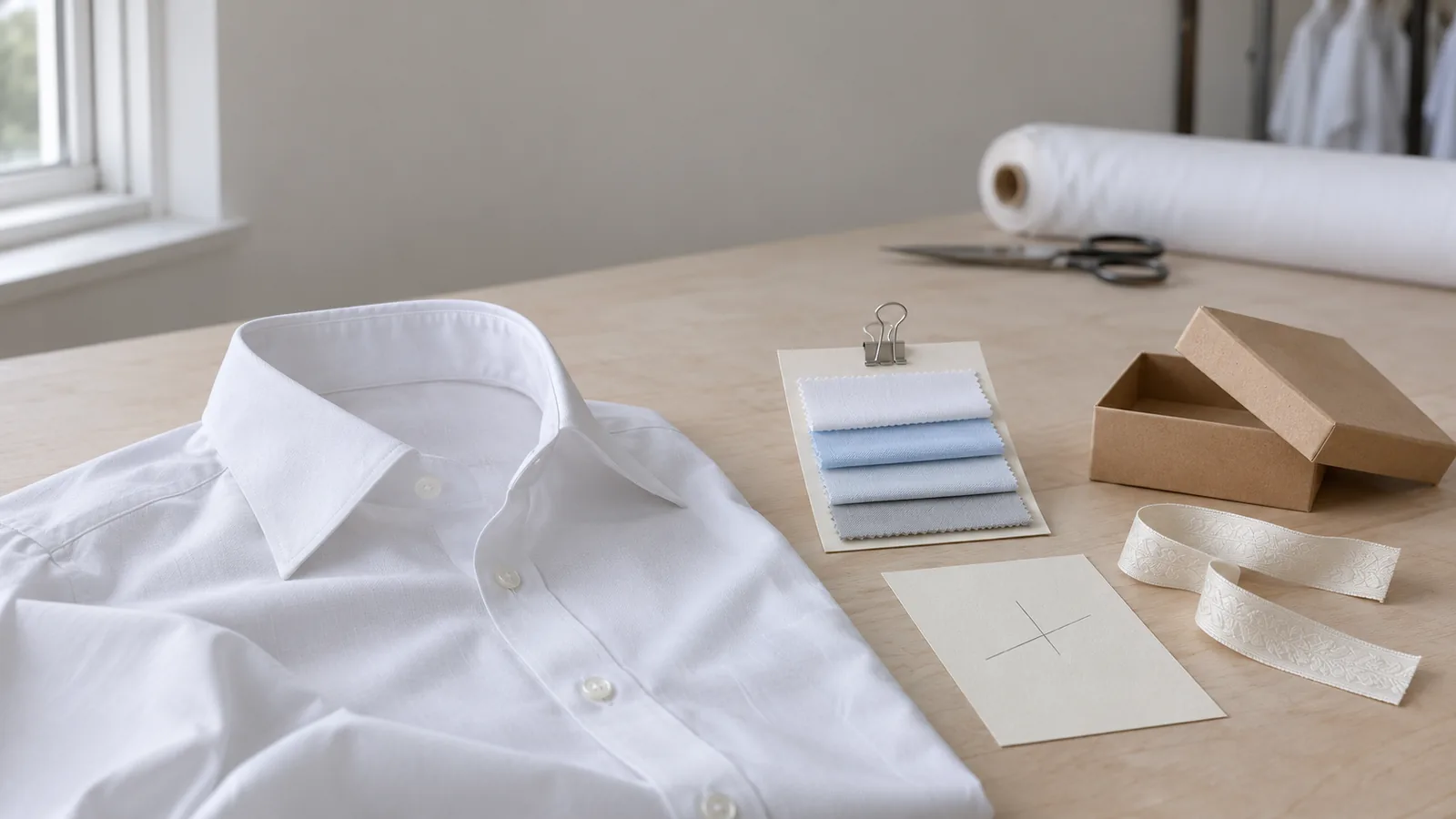
The request is reasonable. The costs need a place to sit.
A new brief often arrives as one sentence: “We want our own shirt. Our fabric, our logo, our neck label, our box. The first order is small, because we are testing.”
That is a fair picture of a finished brand. The shirt should look like yours, not like a factory sample with someone else’s name in the collar. The factory can make all four of those custom items. The only question is how the setup for each one is paid for, when the first quantity is still a test.
Those setups do not get smaller just because the order is small. They are the same work at 100 shirts and at 1,000. On a quotation, that shows up as a higher cost on each shirt, or as a separate development line. Neither is a judgement of the brand, and neither means the factory is short of skill. It is only the quantity that has not yet grown large enough to spread the work thinly.
Fixed costs and variable costs
Shirt production has two kinds of cost, and they behave differently.
Variable costs move with the number of shirts: cloth actually cut, sewing minutes, buttons, thread, embroidery stitches on each garment, individual bags, freight by weight. Order more, and these lines go up. Order fewer, and they go down.
Fixed costs are paid to get a process ready. They change little, or not at all, if you make 100 shirts or 1,000. Digitizing a logo into a stitch file is one piece of work. Preparing a woven or printed neck label for your artwork is one piece of work. Making a print plate for a box is one piece of work. A mill’s dye lot is sized for the vat, not for your first run. Someone has to pay for that preparation. On a large order, each shirt carries a thin slice. On a small order, each shirt carries a thick one, unless you pay the setup as its own line.
Both paths are open. You can have every custom item on the first order by paying the development charges. Or you can start with in-stock cloth, standard trims and logo embroidery (the one-time digitizing setup is charged as normal), and add neck labels, custom cloth and packaging as later volume spreads those setups. For a first test, the second path is usually the more practical one, because it gives you a real shirt, with your mark, without asking a short run to carry the heavier long-run costs.
The factory can make the full brief. Setup is paid once, and quantity is what spreads it. Version one includes logo embroidery, with the one-time digitizing setup charged as normal. If you also want your own neck label, cloth and packaging on a first, small order, pay those setups. If you want a lighter first cost, add those heavier items as the orders grow.
Four development items, and what each one actually involves
The factory can develop all four. The notes below are about how each setup behaves, not about whether the work can be done.
Custom fabric
A factory’s garment minimum and a mill’s cloth minimum are two different numbers. The factory can cut and sew 100 shirts of a style. A special cloth is quoted in metres, and often in metres per colour. A first shirt order may use only a portion of that cloth. The rest is leftover yardage, which is still part of the lot and still has to be paid for.
A new shade is a heavier step than a new length of a running colour: it needs lab dips, a dye-lot booking, and time while the lot is dyed and approved. Three colours usually means three lots, not one lot split three ways.
This is often the largest of the four setups, which is why many first collections postpone it. That is a cost decision, not a capability decision. BERKAM holds a public fabric library of existing cloths, with catalogue references such as JT0004-01, JT0001-02 and JT0030-01. Those are starting points for a first collection, not a promise that every colour is in stock at the moment you enquire. Availability is confirmed for the actual order. A first collection built on cloth the factory already holds simply does not need a new mill lot. You can still commission your own cloth later, or on the first order if you choose to pay for the lot, including any metres the first run does not use.
Logo embroidery
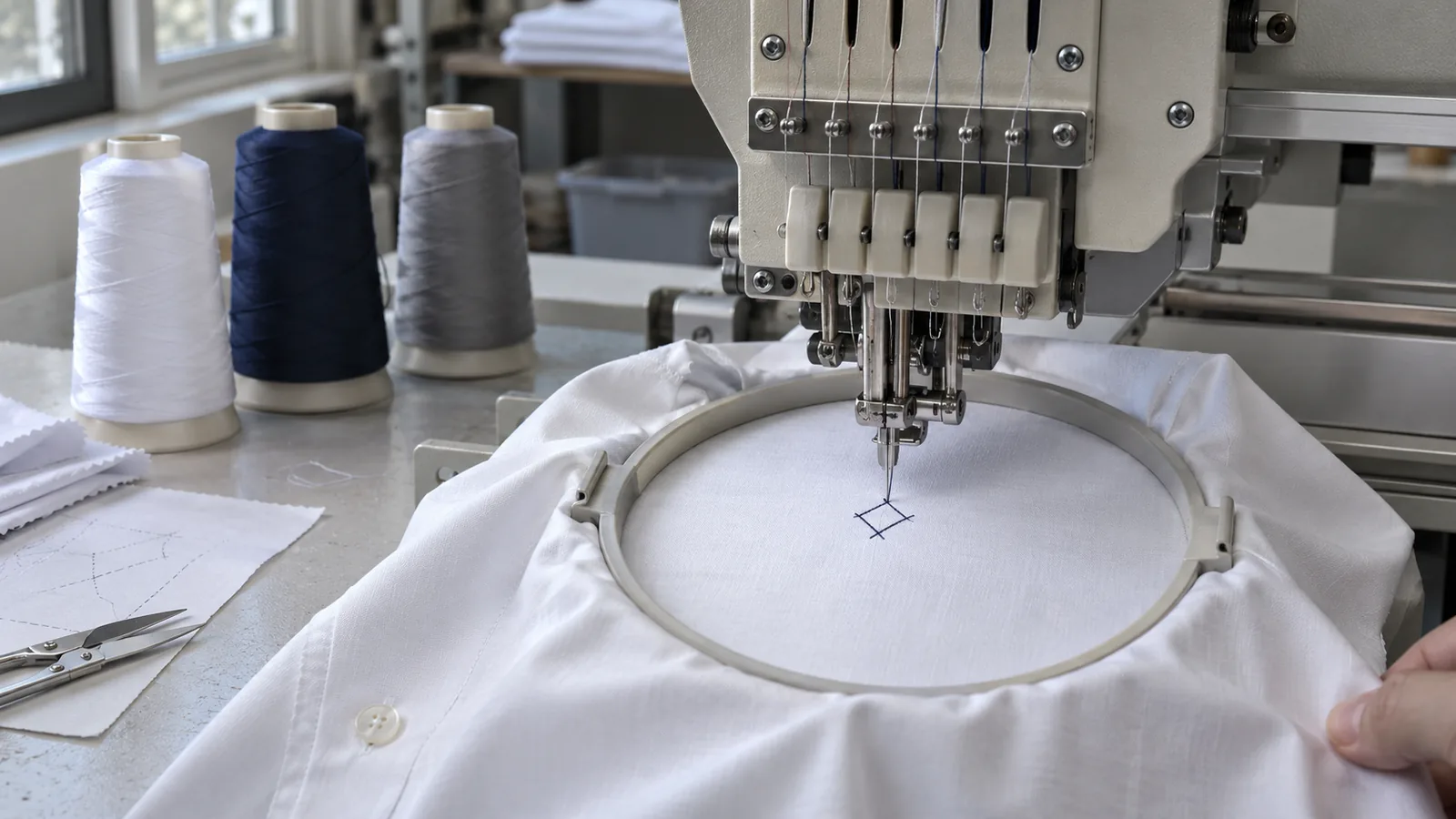
Embroidery does not start with a picture of the logo. It starts with a stitch file. A digitizer converts your artwork into instructions the machine can sew, at a chosen size, density and thread sequence, on the actual cloth. That work is done once per logo and, usually, once per size. If the logo later gets larger or smaller, a new file is needed.
The fee is a setup charge, not a per-shirt charge. The file is stored and reused on later orders of the same mark at the same size. Relative to custom fabric, woven labels and packaging, this is the lightest of the four fixed costs: one file, not a warehouse of unused components. Version one includes logo embroidery. The one-time digitizing setup is charged as normal, and a stitch-out is approved on the real fabric before bulk. Treat it as a development line, not as something that appears for free because the shirts are already being sewn.
Artwork should be a vector file (AI, EPS, PDF or SVG) or a clean, high-resolution original. A logo with fine gradients or very small lettering may need to be simplified before it will sew cleanly. That conversation belongs in sampling, which is described on the customisation process page.
Neck labels
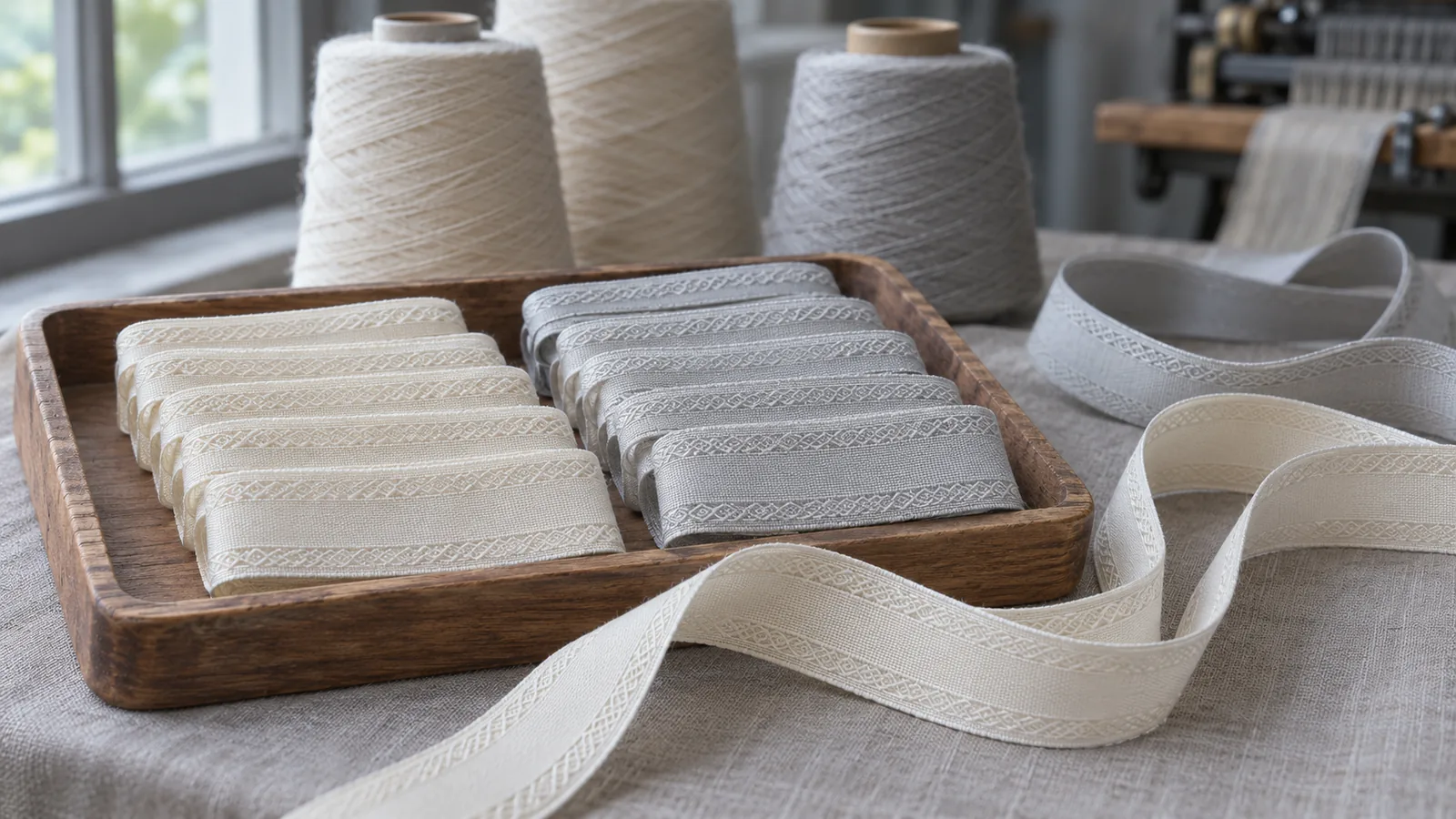
A woven neck label is a small textile of its own. It has artwork, colours, a fold (centre fold, end fold, and so on), a size, and a stitch position at the neck or side seam. Preparing that design has its own setup, and label runs are typically counted in labels, not in shirts. That figure is separate from the shirt minimum.
If you order 100 shirts and the label run is larger, the extra labels are paid for on this order and held for a later one that uses the same design. That is a good use of money once you know the mark is stable. It is a heavier cost on a first test, when the name or the fold may still change. A printed label can be lighter to set up than a woven one, but it still has artwork, wording and an approval step. Care and composition labels are a different job again: they carry fibre content and washing instructions required by the destination market, and the wording has to match the actual cloth. Those can often follow a standard layout. The brand name in the collar is the part that needs its own setup.
On a first collection, a standard factory neck treatment and a correct care label will finish a wearable, saleable shirt. Your own woven mark can be specified on the next run, when leftover labels or a larger shirt quantity can spread the label run, or on the first run if you are ready to pay for that setup now.
Packaging
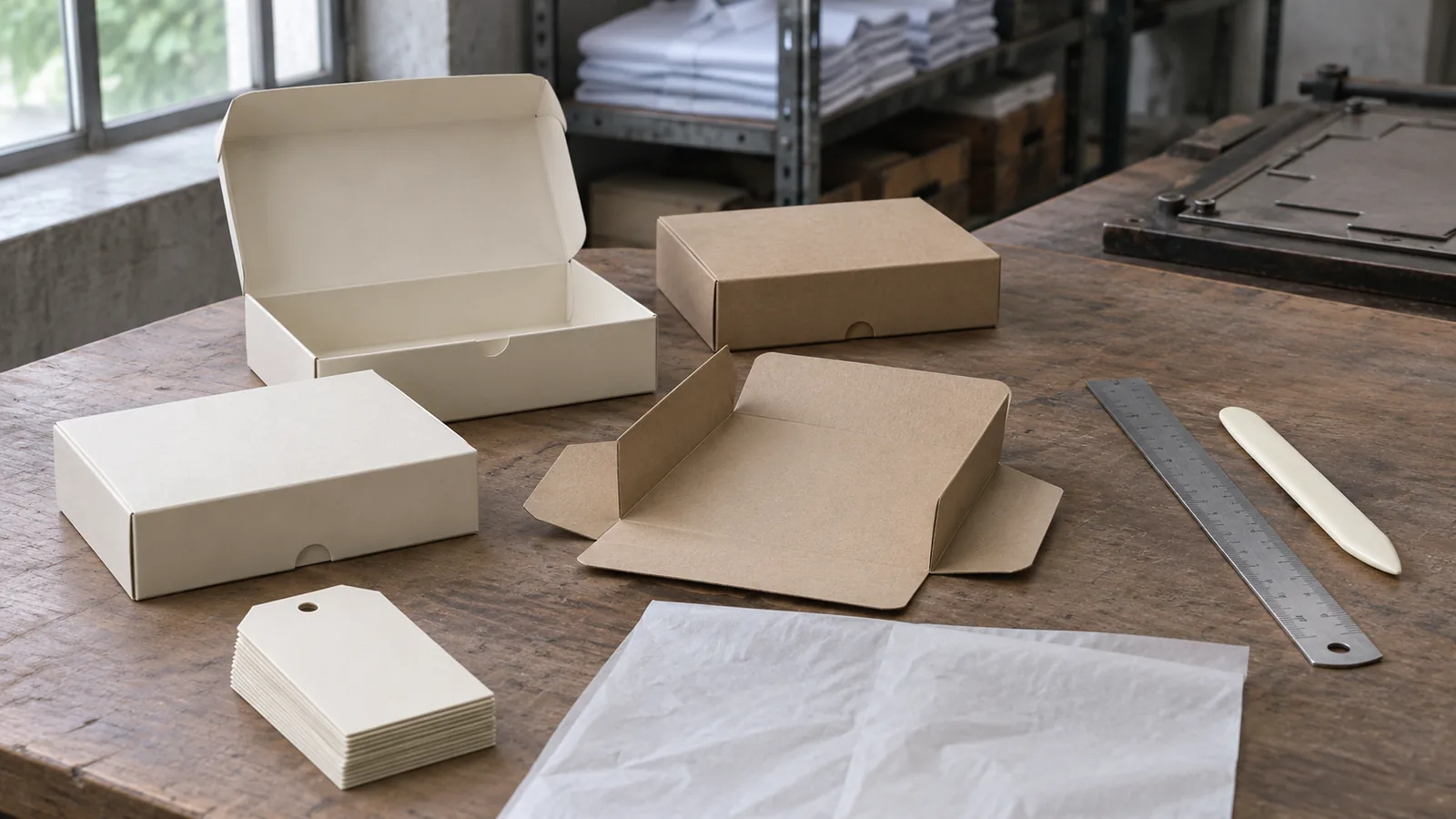
Custom packaging is the item buyers most often underestimate. A printed box, a branded bag, tissue, a hang tag with a string and a special fold all involve print plates or dies, artwork approvals, and a packaging run of its own. The work is closer to a print job than to a sewing job, and the setup can sit very heavily on a first shirt order.
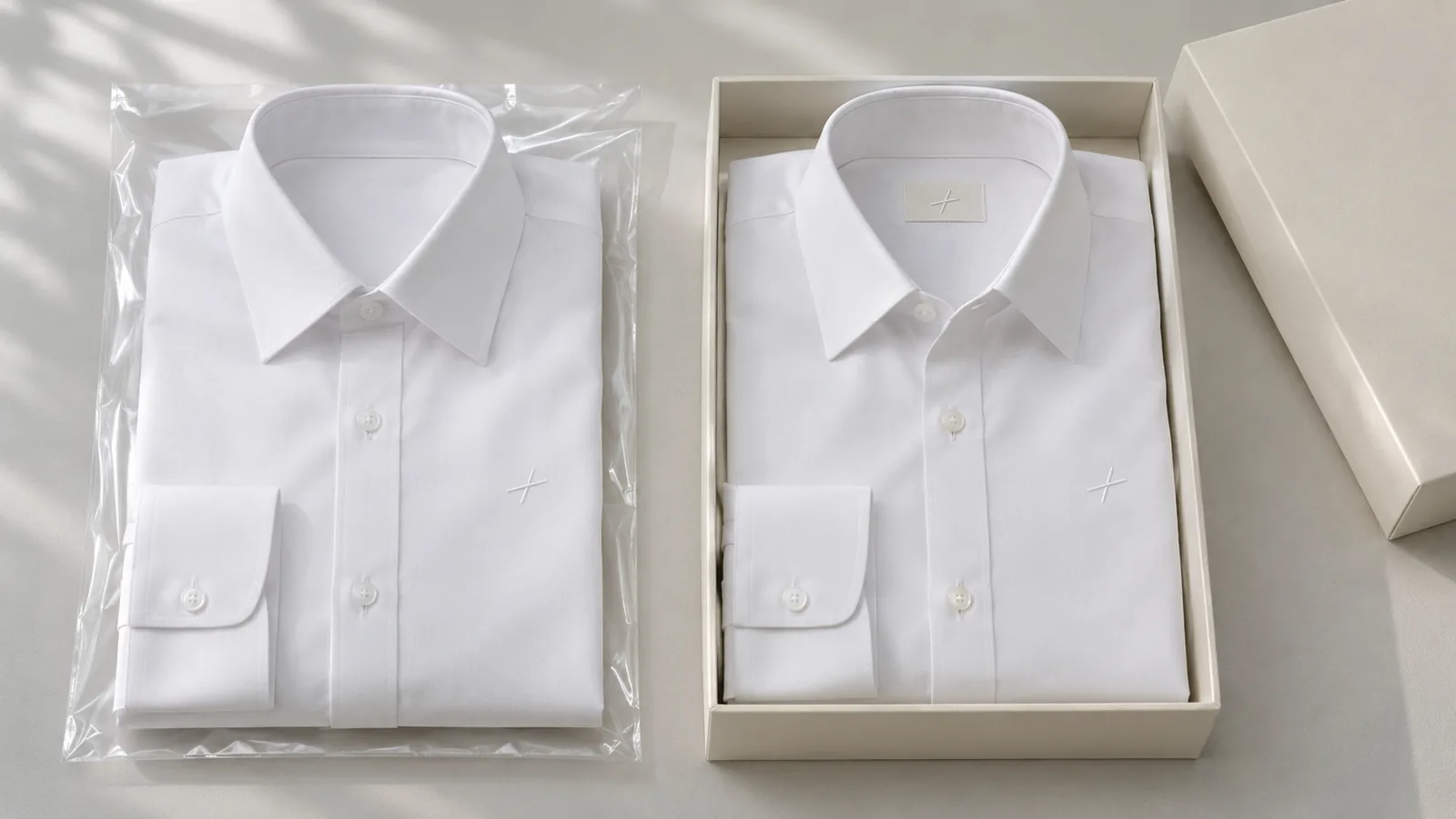
The factory can produce that packaging. Packaging also has to do a practical job: identify the style and size clearly enough for receiving and for reorders. A “premium unboxing” request, without a defined format and artwork, is not yet a specification. For version one, a consistent factory fold and a plain individual bag are enough. Branded presentation can be added when the volume can spread the print setup, or earlier if you set money aside for it.
The private label shirt manufacturer page is the right place to record packing once you are ready to specify it.
What the costs look like side by side
The figures in the last column of the example row are not a BERKAM quotation. The table is here to show how the costs behave. Actual charges are confirmed in a project quote.
| Item | What the setup pays for | Why it is fixed | On a small first order | When it belongs |
|---|---|---|---|---|
| Custom fabric | Mill weaving or dyeing, lab dips, and any leftover yardage | The mill quotes in metres, often per colour, not in shirts | In-stock or library cloth keeps the first cost light. Your own cloth is available if you pay for the lot. | When the run uses enough cloth, or you choose to fund the development now |
| Logo embroidery | Digitizing: one stitch file per logo and, usually, per size | The file is written once and reused on later orders | Part of version one. The one-time setup is charged as normal; approve a stitch-out. | Version one |
| Neck labels | Artwork, loom or print setup, and a label run counted in labels | You may buy more labels than this order will sew | A standard neck treatment and a correct care label. Your own mark if you pay the setup. | On a later order that can use leftovers, or now if the mark is already stable |
| Custom packaging | Plates or dies, printed bags or boxes, hang tags, and a packaging run | Often the heaviest setup, and a separate process | Standard fold and a plain individual bag, unless you fund the print setup now | When unboxing is part of how you sell, and the quantity can spread the setup, or earlier if you pay it |
| Sampling | A physical garment (and, if used, a stitch-out or label) to approve before bulk | Charged per development brief, not per bulk shirt | Budget for it; sampling and production are separate periods | Before any bulk cut |
An illustrative example, not a quote
The numbers below are round figures for teaching the arithmetic. They are not BERKAM’s fees, and they are not an offer.
Suppose three one-time setup charges (digitizing, a woven-label loom setup, and a printed-box plate) add up to 600 dollars, and the order also includes leftover labels or cloth bought to meet a component run. On an 80-piece first order, 600 dollars of setup is 7.50 dollars sitting on each shirt before the garment itself is paid for. On an 800-piece order, the same 600 dollars is 75 cents a shirt. The factory’s work did not change, and the setups did not get cheaper. They were spread.
If those 80 shirts also leave unused labels or unused metres, that is a second bill, paid today for product a later order can use. On a first test, many buyers prefer not to create those leftovers yet. On a first order where you already know the design will repeat, paying for them can be a sound choice.
The factory can make all of this. Quantity is what spreads the cost.
A complete private-label shirt is ordinary work for a factory that already cuts, sews, embroiders, labels and packs dress shirts. BERKAM does this work. The factory coordinates the garment with the cloth, the stitch file, the neck label and the packaging. None of that is out of reach on a first order.
What a first, small quantity cannot do is make those setups look small on a per-shirt line. The preparation is almost the same at 100 pieces and at 1,000. Volume spreads it. A development charge pays for it up front. Staging the brief (in-stock cloth, standard trims and logo embroidery first; neck labels, cloth and packaging later) leaves the heavier setups until a later order can spread them. Those are three honest ways to place the same work. The third is the one we recommend for a first test, because it gets you an approved shirt, with your mark, at a cost that matches a trial quantity. It is a recommendation about timing, not a limit on what can be made.
A neck label alone still does not define the whole product. A complete brief needs a garment that can be reproduced: measurements, an approved sample, and a fabric confirmed for the order. OEM and ODM work starts from that specification, not from a mood board.
What a sensible first collection looks like
Version one should prove the shirt, including your embroidered logo. Custom neck labels, special cloth and branded packaging can follow, or they can be included now if you pay those setups.
- Cloth: choose from fabrics the factory already holds. Compare swatches for hand, opacity and colour. If you will later claim an easy-care or non-iron finish, that claim has to rest on the actual cloth, not on a name. The fabric library and the dress shirt range are the right starting points. Your own cloth is a later step, or a first-order step with its development cost in the quote.
- Block and details: use a proven collar, cuff and fit, or configure them in the shirt configurator. Record measurements for the size run you will actually order. A new pattern for one small test is another development cost, and it can be quoted if you want it.
- Trims: standard buttons, standard interlining, a standard neck treatment, and a care label whose wording matches the cloth and the destination market.
- Branding: logo embroidery is part of version one. The one-time digitizing setup is charged as normal. Send artwork and approve a stitch-out on the real cloth before bulk. A well-made shirt with a settled mark is a strong first product.
- Packing: consistent fold, plain individual bag, carton marks that identify style and size, unless branded packaging is in this brief and its setup is in the quote.
- Quantity: at BERKAM, the minimum is 100 pieces. Keep the first colour count low. Each extra colour is another fabric decision.
- Sample: sampling takes 10–15 days, with charges confirmed for the garment, fabric and artwork. Approve the physical shirt before bulk. Production then follows the route in the quotation: 15 days for logo-customised products, 45 days for full customisation, after approval, transit excluded.
Corporate buyers issuing a first branded shirt to a small team can use the same version-one brief. Role-by-role options are in the custom dress shirt options guide. Employee logo programmes that start from a simpler “add a mark” brief have a separate corporate shirts page.
When to add each custom item
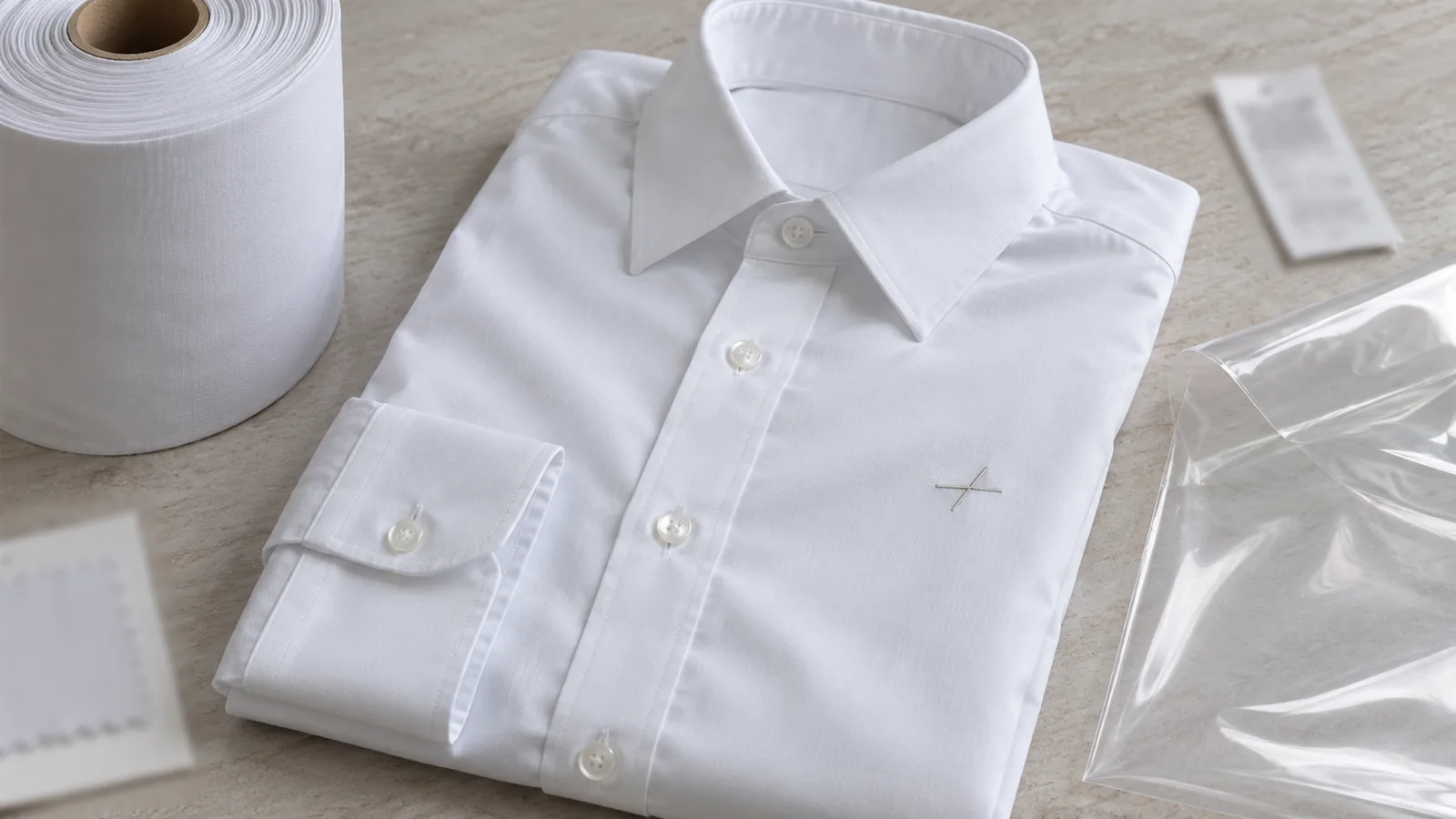
There is no single “right” month. The practical test is: can this order use what the setup will produce, and is any leftover useful? If you want the item sooner, the same setup can be paid now.
- Embroidery belongs on version one. The leftover is only a file, not a box of parts. The one-time digitizing setup is charged as normal. Approve size and placement on a stitch-out, then reuse the file on later orders.
- Neck labels sit comfortably on the order where you can sew most of the label run, or where you already know a second order will use the rest. If you later have labels of your own, ask whether the factory can sew a customer-supplied label; it still has to be approved on a sample for size, fold, stitch and comfort against the skin.
- Custom fabric sits comfortably on the order that can use the cloth, including a planned reorder, or when you are ready to pay for leftover metres. Sharing one cloth across more than one style helps. Opening three new shades at once multiplies the lots.
- Custom packaging sits comfortably when the presentation is part of how the shirt is sold, and the print run can be spread. It can also be part of the first order if that presentation matters enough to fund the setup.
Keep a record as you go: fabric code, measurement chart, artwork, label version, packing notes, and the approved sample. That record is what makes the second order a continuation, not a new development. How a shirt is cut, sewn and packed is described in the shirt factory process article.
What to send so the quote is honest
A useful first enquiry is smaller than a complete brand manual, unless you already know you want the full brief and are ready to see the setups in the price. Send:
- The style direction, or a reference shirt, and whether you can start from a library fabric or a catalogue style.
- Estimated quantity by style and colour, and the size breakdown if you have it.
- Whether this is a first test or a programme you already know will repeat.
- Logo artwork for the embroidery that sits on version one (a vector file, and the intended size and placement).
- Destination market, so care-label wording can be discussed.
- A clear note on what you want on this order and what you are happy to leave for a later one: your own neck label, your own cloth, your own box. If you want all of them now, say that too, so the quotation can include the setups as visible lines.
A staged brief and a complete brief can both be quoted honestly. The difference is where the setup sits: on this order, or on a later one. Saying which path you prefer is the most helpful thing you can do in a first message.
Five mistakes that make a first order heavier than it needs to be
- Asking for a special fabric, a woven label and a branded box on the first 100 pieces, without allowing for their setups. The factory can do the work. The quote will simply show those setups on a short run. Stage the brief, or accept the development charges, and the price will make sense.
- Expecting setup to nearly vanish at any quantity. It becomes a thin slice only when the run is long enough. On a short run it is visible, which is the honest figure, not a penalty.
- Opening three new colours of a cloth that does not yet exist. Each colour can be its own dye lot. Start from colours that already exist, or budget for each lot.
- Approving a logo from a screen mock-up only. Embroidery is thread on cloth. Approve a stitch-out.
- Leaving label wording until after the fabric is chosen. Care and composition text has to match the cloth and the market. Decide them together.
The project request page is the place to send the brief, staged or complete.
FAQ
Can a factory make my fabric, logo, neck label and packaging on a small first order?
Yes. The factory can make all of these. Each item has a fixed setup cost, and a small quantity cannot spread that cost thinly. Version one includes logo embroidery, with the one-time digitizing setup charged as normal. You can also pay for your own neck label, cloth and packaging on the first order, or add those as later orders grow. The second route is usually the more practical first step. It is a choice about cost, not about what the factory is able to do.
What is an embroidery digitizing or setup fee?
It is the one-time cost of turning your artwork into a stitch file for a chosen size and fabric. You pay it for a new logo or a new size, not on every reorder of the same file. It is usually the lightest of the custom-branding setups.
Are woven neck labels charged per shirt?
The sewing can be a per-shirt line. The label itself is a separate product, with its own setup and, typically, its own run counted in labels. On a short shirt order you may buy more labels than you sew on this order; the extras are held for a later run of the same design.
Is custom packaging really more expensive to set up than a label?
It often is. Boxes, printed bags and tags are print jobs, with plates or dies and their own runs. A first collection can ship in a plain bag and still be a finished shirt. Branded packaging can be added when you are ready to spread, or pay, that setup.
What should a first private-label shirt collection include?
A proven shirt block, in-stock fabric, standard trims, a correct care label, your embroidered logo (the one-time digitizing setup is charged as normal), and a sample you have approved, including a stitch-out. Your own woven neck label, special cloth and branded packaging can follow on later orders, or they can be included now if you pay those setups.
What is BERKAM’s minimum order and timing?
The minimum is 100 pieces. Sampling takes 10–15 days. Logo-customised products have a 15-day production period; fully customised products have a 45-day period. Both are counted after sample and order approval, and transportation is not included.
What happens to leftover custom fabric or leftover labels?
They have already been produced, so they are paid for and stored. They are useful on a later order of the same design. On a first test, many buyers wait until the design is stable. If you already plan a repeat, paying for them on the first order can make sense.
Can I supply my own labels later?
Ask when you brief the next order. A customer-supplied label still needs sample approval for size, fold, stitching and comfort. Do not assume it can be sewn without that check.
Is a neck label enough to define a private-label shirt?
No. The garment, fabric, fit, label content and packing all need to be specified. The commercial private label page sets that out in full.
Start with a first-collection brief
If you are planning a first shirt collection, send the style direction, the quantity by colour (at least 100 pieces), your logo artwork, and which of the remaining custom items — neck labels, cloth, packaging — you want now or on a later order. BERKAM can recommend an in-stock fabric and a version-one specification, including embroidery, and can also quote the rest of the custom brief if you want those setups on this order.