
Security / Guarding / Reception
Security Uniforms for Reception, Posts and Outdoor Patrol
Security contractors and in-house teams at campuses, hotels, commercial buildings, logistics centers, events and residential communities often need distinct apparel for gate posts, patrol, control rooms, visitor reception and supervisors. Brand uniforms must be reviewed separately from regulated insignia, site PPE and authorization rules.
Companies this program fits
For security operations, procurement, HR, client-site managers and compliance reviewers. Contractors serving multiple clients should document each site’s branding, issue, transfer and return rules.
- In-house security for offices, campuses, parks and residential communities
- Security contractors, mobile patrol and event-order teams
- Hotel, logistics-park, retail and transport-hub security teams
Garment mapping by role
This is a uniform-planning guide. Final styles depend on job tasks, climate, care, wearer fit and site rules.
| Garment | Recommended scope | Typical roles | Selection notes |
|---|---|---|---|
| Business shirts | Core identity garment | Lobby security, gate posts, visitor registration, control-room supervisors and customer-service posts. | Set consistent badge and logo placement. Approve colors and marks so they are not confused with a client or public authority uniform. |
| Business suits | Reception and premium posts | Hotel security reception, head-office lobby, VIP entrances and high-end commercial properties. | For formal indoor posts; consider comfort and movement for night patrol or active-response work. |
| Formal vests | Specific indoor posts | Concierge, reception, event entry and formal visitor-facing roles. | A dress style only—not tactical, stab-resistant, ballistic or high-visibility PPE. |
| Jackets | Patrol and transition seasons | Campus patrol, parking posts, mobile patrol and night-shift outdoor supervisors. | Plan around duty duration, night temperatures, communications equipment and movement. Specify any required safety equipment separately. |
| Down jackets / coats | Outdoor posts in cold climates | Winter gate posts, outdoor patrol, parking teams and perimeter checks in large sites. | Set layering for local climate and shift duration. Verify visibility or protective equipment independently when required. |
| Trousers / matching bottoms | Role-based sets | Lobby and concierge security, office supervisors, visitor management and control-room staff. | Dress trousers suit indoor business posts; high-movement patrol roles need their own review for durability, pockets and mobility. |
Catalog fabric starting points
For customer-facing shirts, compare catalog 68001 (50% cotton / 45% polyester / 5% elastane, 190±5 g/m²) with lightweight 68002 (100% polyester, 135±5 g/m²). Y001 lists a 150D mechanical-stretch nylon shell for winter outerwear. Reflective, stab-resistant, ballistic or flame-resistant requirements need separately specified and verified products.
These references come from BERKAM’s 2026 workwear catalog and are starting points for sampling. Confirm final composition, weight, availability, sizing and performance against the project quotation, approved sample and supporting documents.
Safety and compliance boundary: A branded uniform does not confer legal authority and is not automatically stab-resistant, ballistic, flame-resistant or high-visibility PPE. Where a risk assessment requires PPE, select it under the applicable rules, confirm fit and verify product documents. U.S. OSHA 29 CFR 1910.132 is one general-industry reference. OSHA 1910.132
Illustrative procurement scenario
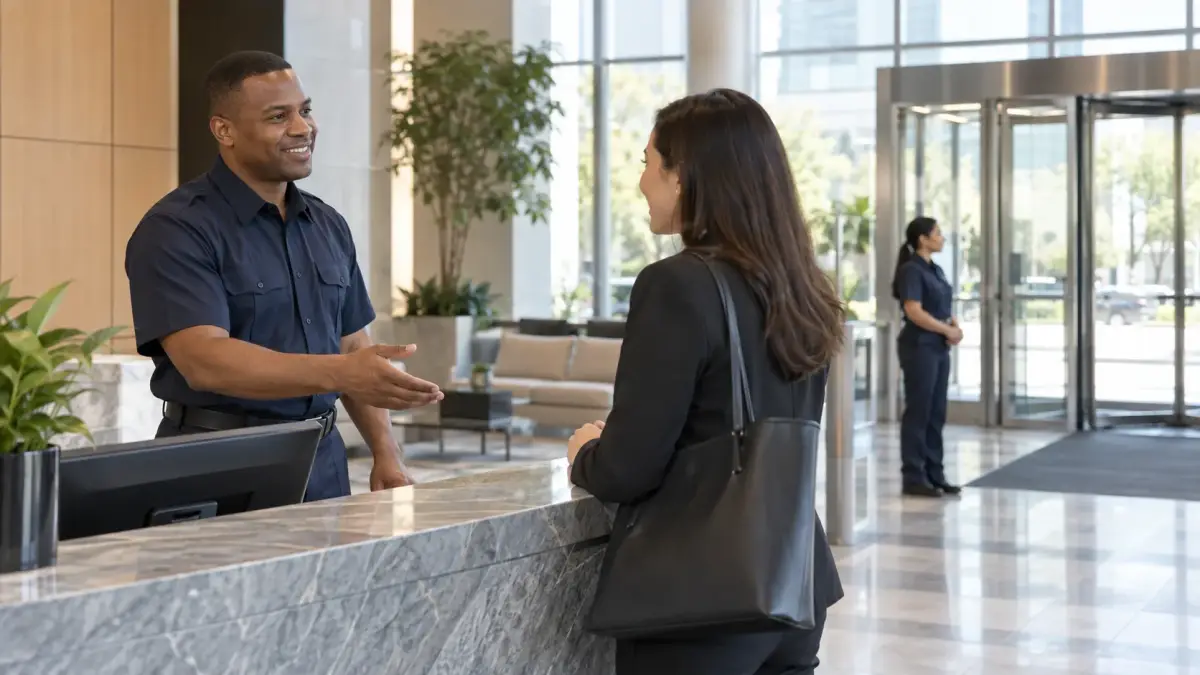
Illustrative plan: a security provider serving a hotel, office tower and logistics park could use shirt / suit or vest combinations for reception, shirts / trousers for control-room and gate posts, and jackets or winter coats for outdoor patrol. Each client site separately approves colors and identifiers. This is a planning example, not a completed BERKAM customer case.
Prepare before requesting a quote
- Separate uniforms by client site, post, shift and indoor / outdoor conditions.
- Have operations and each client approve colors, logos, role marks, name plates and placement.
- Review whether garments accommodate or obstruct actual communications and duty equipment.
- Record movement, night-shift temperature, care method, issue and uniform-return rules.
- Procure and verify high-visibility, stab-resistant, ballistic, flame-resistant or other PPE separately.
Recommended rollout
- List roles, wearer counts, shifts, work zones and wearing seasons.
- Choose garment categories, fabric direction, care and safety boundaries by role.
- Confirm size charts, brand colors, logo method, identifier placement and packing labels.
- Review physical samples and representative sizes; assess PPE documents separately.
- Approve the bulk specification and retain site / department packing and reorder records.
Review BERKAM’s factory and quality process and the sampling and customization workflow.
Frequently asked questions
Brand and role identifiers can be planned after review, but the security company and client should approve them and check local requirements before sampling.
Do not assume they do. Specify the exact product, materials, test method and applicable rules, then verify current supporting documentation.
Maintain a site-level style list and approved sample record covering color, logo, size, issue quantities, packing and return or transfer rules.
Build the program around your role list
Share company type, role counts, garments, work conditions, size range, branding and target date so BERKAM can review the styles, sample and quotation brief.
Send a Uniform Project Brief