
Logistics / Warehousing / Delivery
Logistics Uniforms for Warehouses, Branches and Field Teams
Third-party logistics, freight forwarders, parcel networks, e-commerce fulfillment centers, cold-chain operators and last-mile delivery businesses combine desk, warehouse, dock, yard and route roles. Uniform plans should distinguish indoor, outdoor and customer-facing work.
Companies this program fits
For logistics procurement, warehouse operations, HR, fleet and branch managers. Multi-site programs should agree on a master palette, wearer-size record and new-hire reorder process.
- 3PL, freight forwarding and customs service companies
- Parcel, courier, sorting and last-mile delivery networks
- E-commerce fulfillment, regional distribution and cold-chain operators
Garment mapping by role
This is a uniform-planning guide. Final styles depend on job tasks, climate, care, wearer fit and site rules.
| Garment | Recommended scope | Typical roles | Selection notes |
|---|---|---|---|
| Business shirts | Branch and customer roles | Freight account managers, customer service, documentation, dispatch supervisors and branch counters. | Unify office, counter and customer-meeting roles. Warehouse staff may need a more mobile, easy-care workwear top. |
| Business suits | Limited use | Sales leaders, regional managers, freight-forwarding business teams and key-account meetings. | For commercial meetings and offices—not routine picking, loading, warehouse or driving shifts. |
| Formal vests | Small, selective group | Air-cargo or freight counters, customer service desks and formal branch reception. | A dress layer only. An ordinary vest is not a substitute for legally or operationally required high-visibility PPE. |
| Jackets | Field and mobile roles | Warehouse leads, yard dispatch, loading coordinators, route supervisors and field drivers. | Fit the jacket to bending, reaching, seated driving, pocket use and shift temperature. Confirm reflective or protective details separately. |
| Down jackets / coats | Outdoor roles in cold climates | Open yards, dock coordination, winter last-mile delivery and outdoor route checks. | Plan by local climate and outdoor duration. Cold-store roles need a separate review of temperature, layers and task rules. |
| Trousers / matching bottoms | Customer-facing roles | Freight business teams, branch counters and branch managers. | Use dress trousers for office and counter roles; define durable, mobile work pants separately for warehouse, driving and loading. |
Catalog fabric starting points
Catalog starting points: C1–C9 utility workwear is T/C 65/35, 155±5 g/m², S–5XL; D101–D106 is 98% nylon / 2% elastane, 150±5 g/m², S–5XL. Compare samples against temperature, movement and care. Y001 lists a 150D mechanical-stretch nylon shell and several fill directions; these descriptions do not establish high-visibility rating or cold-store suitability.
These references come from BERKAM’s 2026 workwear catalog and are starting points for sampling. Confirm final composition, weight, availability, sizing and performance against the project quotation, approved sample and supporting documents.
Safety and compliance boundary: Where PPE is required, select it from the workplace hazard assessment, confirm fit and verify applicable documentation. U.S. OSHA 29 CFR 1910.132 is one general-industry example; check the governing rules in each operating jurisdiction. Branded workwear is not automatically PPE. OSHA 1910.132
Illustrative procurement scenario
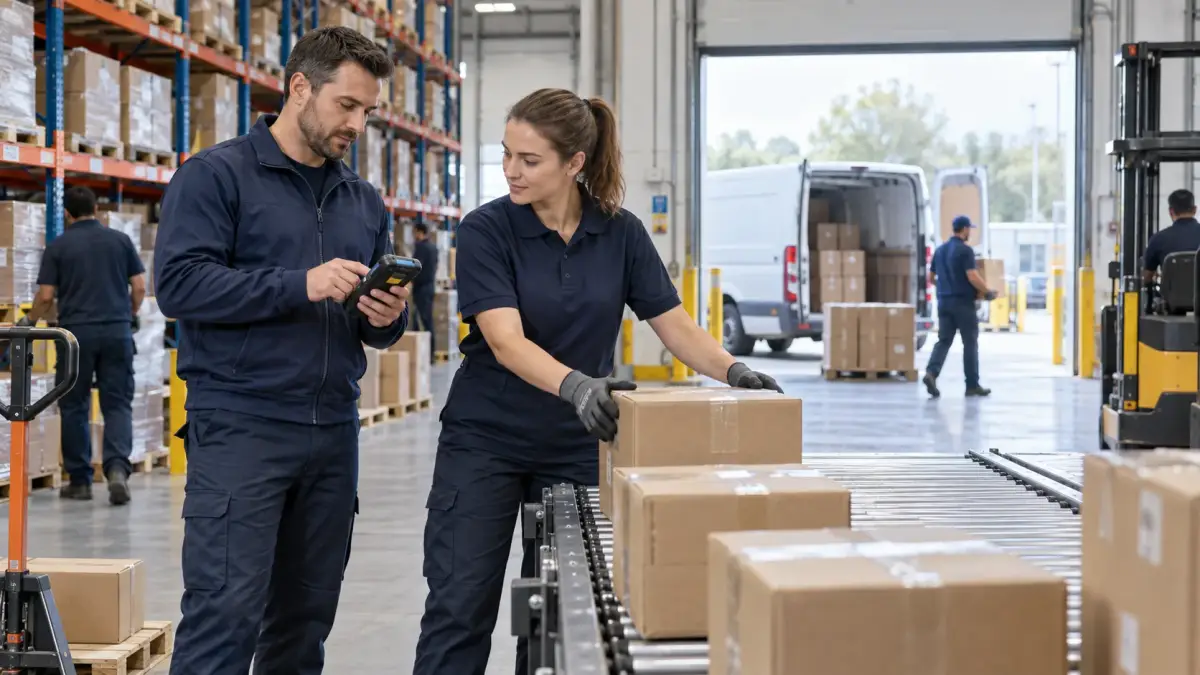
Illustrative plan: a 3PL with a regional distribution center, staffed branches and last-mile routes could use shirts / trousers at counters, workwear / jackets for warehouse leads and dispatch, and seasonal down coats for outdoor winter shifts. If high-visibility PPE is required, specify and verify its class, color, reflective material and documentation separately. This is a planning example, not a completed BERKAM customer case.
Prepare before requesting a quote
- Separate office service, warehouse picking, dock and yard, driving and cold-chain environments.
- Specify shift temperature, handling movements, driving posture, pocket use and laundry frequency.
- Keep brand clothing separate from high-visibility or other PPE requirements and acceptance records.
- Record palette, logo position, department labels, size rules and carton labels by site.
- Plan site and route packing, seasonal teams, new-hire issues and replacement orders.
Recommended rollout
- List roles, wearer counts, shifts, work zones and wearing seasons.
- Choose garment categories, fabric direction, care and safety boundaries by role.
- Confirm size charts, brand colors, logo method, identifier placement and packing labels.
- Review physical samples and representative sizes; assess PPE documents separately.
- Approve the bulk specification and retain site / department packing and reorder records.
Review BERKAM’s factory and quality process and the sampling and customization workflow.
Frequently asked questions
Usually only sales, counter or management roles need suits. Picking, sorting, loading, driving and outdoor delivery teams need workwear suited to movement and site requirements.
Do not assume so. If the task assessment or local rules require high-visibility PPE, specify it separately and verify traceable product documentation.
Keep one approved style, color, measurement method, logo file and packing-label record; use a common size record across sites and retain the approved sample.
Build the program around your role list
Share company type, role counts, garments, work conditions, size range, branding and target date so BERKAM can review the styles, sample and quotation brief.
Send a Uniform Project Brief