
Industry Insights
How to Choose a Uniform Manufacturer
How to evaluate uniform manufacturers before you commit: fabric evidence, sizing, sealed sample control, branding, QC checkpoints, MOQ and reorder terms.
Quick answer: Compare uniform manufacturers against the same written brief for fabric, fit, sampling, construction, branding, inspection, delivery and reorders. A quotation is comparable only when its specification, inclusions and repeat-order terms match.
By BERKAM Editorial Team · Updated September 19, 2026.
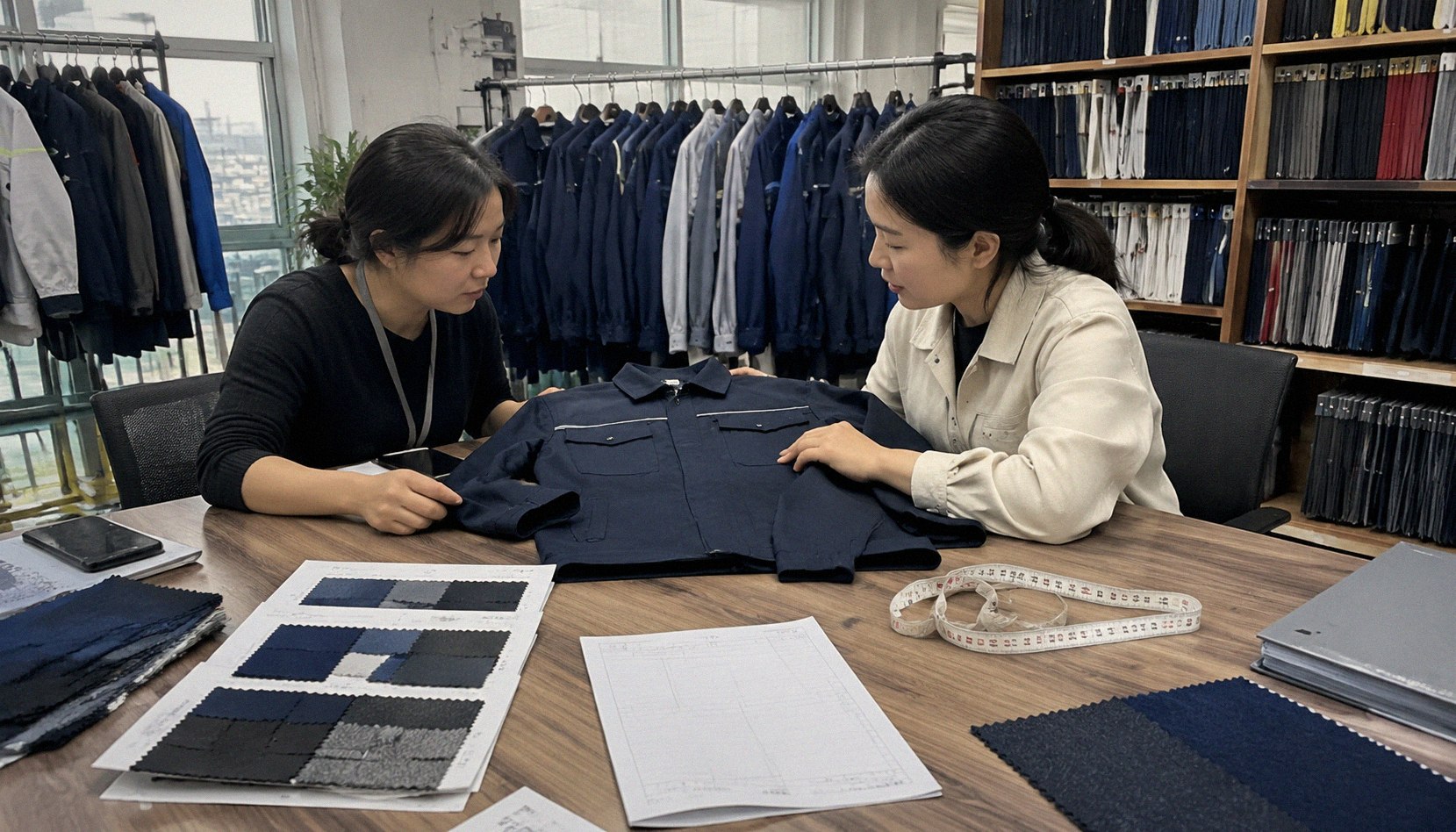
From the BERKAM showroom floor: a uniform programme review covering garment construction, fabric swatches and specification before sampling.
Evaluation benchmark
A supplier comparison should run against one written brief: the roles covered, the wear environment, the washing process, the required size range, branding positions, expected service life, order quantity, reorder frequency, and the destination market. Without that brief, each supplier is answering a different question, and the quotations cannot be compared line by line.
1. Start from the programme, not the price list
Uniform buyers often request a price against a photograph. That produces a number, but not a comparable one.
Before contacting suppliers, write down what the garment has to do. A hotel front-desk shirt is worn indoors in a controlled climate and laundered frequently. A logistics workwear jacket is worn outdoors, stretched, and abraded against equipment. The same budget buys very different garments in those two cases.
A programme brief at minimum records:
- Roles and headcount, split by department and gender.
- Wear conditions: indoor, outdoor, temperature range, physical activity, contact with oil, chemicals or machinery.
- Laundry method: home wash, commercial laundry, or dry clean, and the expected frequency.
- Size distribution, not just the size range, so the supplier can plan grading and fabric consumption.
- Branding positions and the method the logo requires.
- Expected service life, expressed in months or wash cycles.
- Quantity, delivery window, and reorder expectation.
A supplier that responds to this brief with questions is usually more useful than one that responds immediately with a price.
2. Ask for fabric evidence, not fabric adjectives
“High quality”, “breathable” and “premium cotton” describe nothing a buyer can verify.
When evaluating fabric, request the data that will actually be attached to your order:
- Composition and yarn details, such as the blend ratio or yarn count.
- Fabric weight, stated in a standard unit, plus the actual swatch.
- Construction and finishing, including any easy-care, water-repellent or stain-release treatment.
- Colour fastness and shrinkage data, with the test method used.
- Certification or test reports where the destination market requires them, together with the version, scope and validity date.
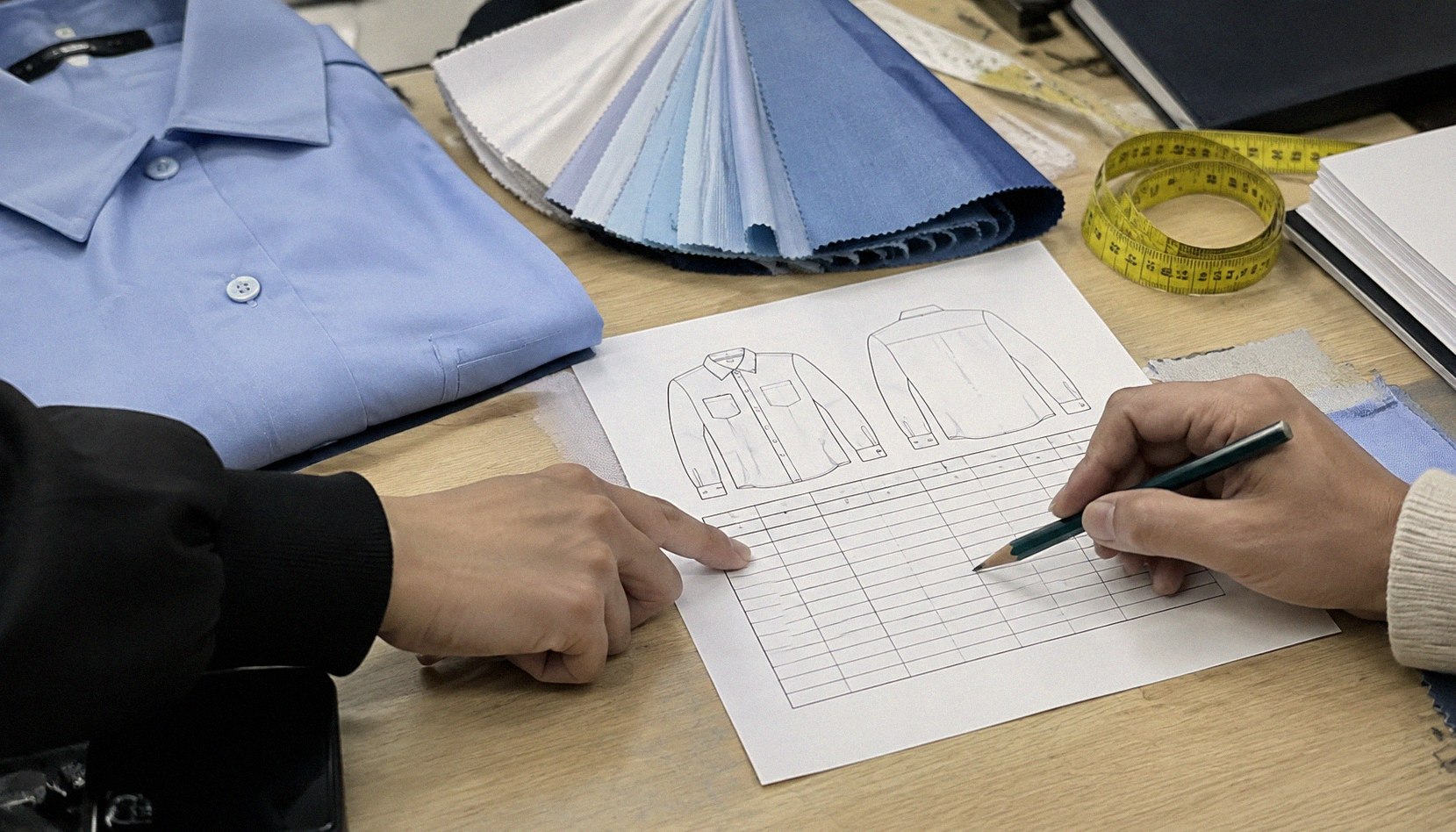
Workshop detail: a specification review before sampling, where composition, weight, tolerances and branding positions are confirmed against the buyer’s brief.
Two practical checks matter here.
First, ask whether the data describes the fabric you will receive or a catalogue reference. A swatch book is a direction, not a commitment.
Second, ask who owns the test evidence. Reports issued for another customer’s specification do not automatically apply to your fabric, your colour or your finishing route.
Where a programme needs the fabric to be repeatable, ask how the manufacturer records the approved swatch, the dye lot and the shade reference, because that record is what protects your second order from the first order.
3. Check pattern and sizing capability, not just size labels
A size label is not a pattern.
Uniform programmes cover a wide spread of body types, and a factory that only converts a stock block into a size run will produce garments that fit a few people well and everyone else approximately. Ask directly how the supplier handles this.
- Pattern origin: is the block developed for your programme, or adapted from an existing style?
- Size set: can the supplier produce a graded size set before bulk cutting?
- Fit trial: can representative wearers from different departments try the garments and give structured feedback?
- Tolerance: what measurement tolerance applies per point of measure, and how is it recorded?
- Gender and body-type coverage: how are women’s cuts, larger sizes and non-standard proportions handled?
A supplier who can explain grading and tolerance in specific terms is describing a real capability. A supplier who answers with “we have all sizes” is describing a stock list.
4. Control the sample, then seal it
The sample stage is where most uniform programmes are won or lost, and where most delivery time is lost.
Each revision round means re-cutting, re-sewing, re-checking and re-approving. Programmes that produce scattered feedback over four rounds take far longer than programmes that consolidate clear comments into one or two rounds.
When giving sample feedback, state the point of measure or the part of the garment, the direction of the change, and the reference garment you are comparing against. “The sleeve feels long” is weaker than “the sleeve is 15 mm long at the cuff compared with sample B; shorten it and keep the cuff width.”
Once a sample is approved, confirm what it becomes:
- Is the approved sample physically retained by both buyer and factory, with a signed reference?
- Does the retained sample record fabric, colour, trims, branding and construction notes?
- Are the approved measurements written into a specification that production and inspection both work from?
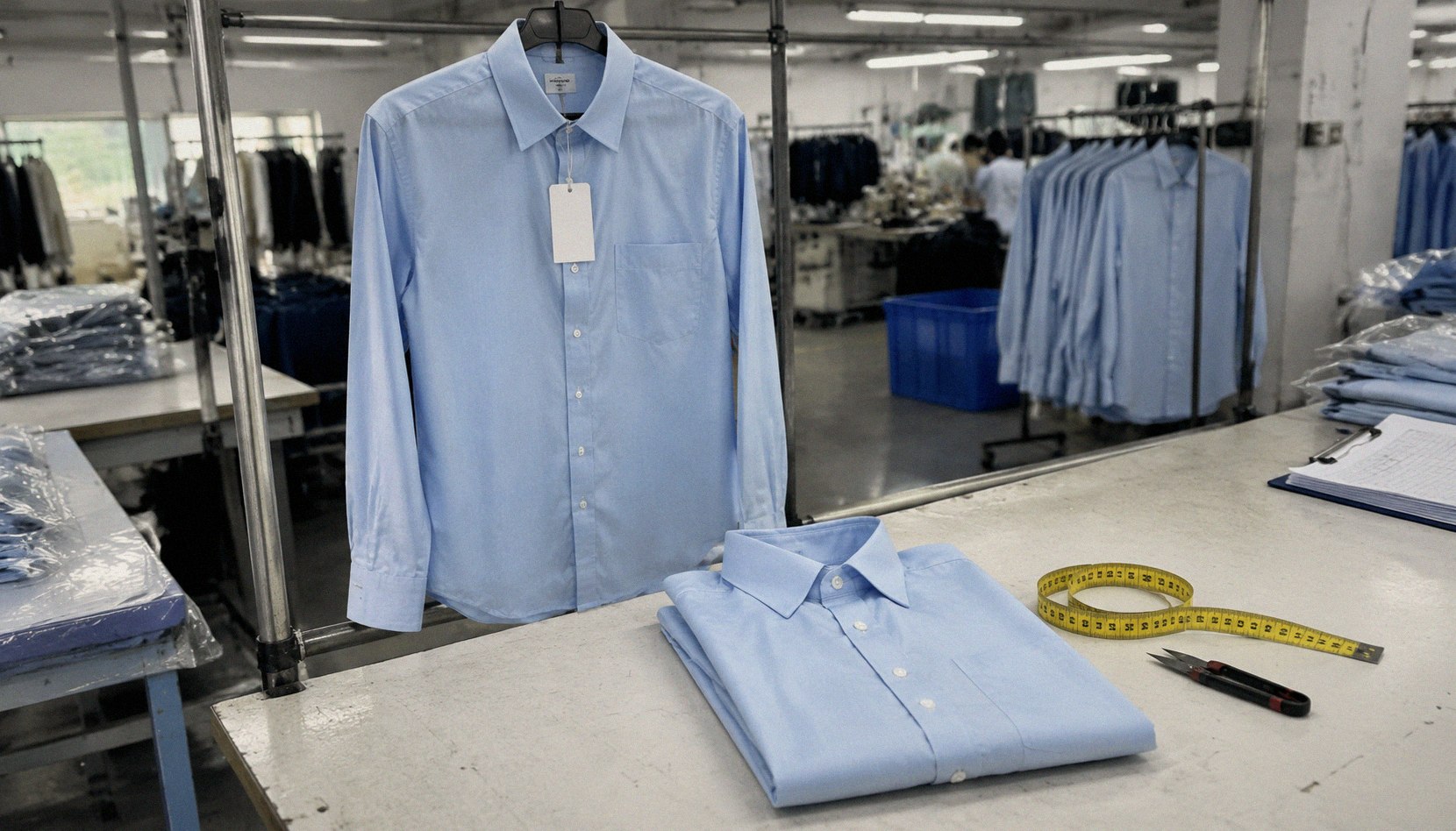
Workshop detail: the sealed approved sample and a bulk garment compared side by side — the reference that both buyer and factory inspect against.
A photograph of a sample is a useful record and a poor standard. Hand feel, shade and construction need a physical reference.
5. Look at stress-point construction
Uniforms do not usually fail across the whole garment. They fail at specific points: pocket corners, placket ends, crotch seams, elbow areas, and wherever a pocket is repeatedly loaded.
Ask how the supplier handles these areas before production, not after the first complaint:
- Bar-tacks or equivalent reinforcement at pocket openings, pocket corners and placket ends.
- Seam construction appropriate to the fabric and the movement of the wearer, including double-stitched or locked seams at major joining points.
- Ease and articulation at elbows, knees and shoulders so the fabric is not permanently strained.
- Stitch density appropriate to the fabric weight and the stress on the seam.
- Closure and trim quality, including zip specification and button attachment.

Workshop detail: stitch density and reinforcement checked along a seam at a stress point during quality control.
This is the area where two garments that look identical on a hanging rail differ most, and where the gap between quotations is often explained. It is worth asking which of these features are included in the quoted price and which are treated as extras.
6. Confirm how branding will be applied and how it survives washing
Corporate uniforms must remain identifiable after months of use. Branding that cracks, fades, puckers or irritates the skin creates a replacement programme you did not budget for.
Ask the supplier to document:
- Method: embroidery, screen print, heat transfer or woven patch, matched to the fabric weight and logo detail.
- Placement: exact position on each garment, with tolerance, so that garments from different production runs remain consistent.
- Wash durability evidence for the chosen method on the chosen fabric, tested after the actual laundry method your programme uses.
- Backing, thread and colour references for embroidery, since these decide both appearance and comfort.
- Label and packaging logic: neck labels, care labels, carton references and department-level packing.
If your programme includes any reflective or high-visibility element, confirm the applicable standard, the garment version it applies to, and the current test evidence before any visibility claim is made.
7. Agree the inspection checkpoints and who signs off
“Inspected” is not a quality plan. A quality plan names the checkpoints, the person responsible, and the record produced.
A workable uniform inspection plan covers at least:
- Fabric check against the approved swatch for composition, weight, shade and hand feel.
- Cut and size check against the graded specification and tolerance.
- In-production check of seam construction, reinforcement, pocket position and closure security.
- Branding check for placement, registration, trim and appearance.
- Final check of measurements, workmanship, labelling and packing, with the result recorded.
- Pre-shipment review of carton marking, quantity and packing logic against the order.
Two questions decide whether this plan is real: who is responsible at each checkpoint, and what record exists when something fails. Ask to see a sample inspection record before you place the order.
8. Put MOQ, lead time and reorder terms in writing
MOQ and lead time are project-specific, and no responsible manufacturer should quote them as a fixed promise before reviewing the style.
They depend on the fabric’s availability and its own production lead time, the construction and number of styles, the quantity and size distribution, the branding method, the season, and the inspection schedule. Two suppliers can quote the same garment with very different lead times because they are describing different fabric routes.
Ask for these in writing before confirming an order:
- MOQ per style, per colour, and how it changes with fabric choice.
- Sample cost and turnaround, and whether the sample cost is credited against bulk.
- Bulk lead time measured from a defined start point — fabric booking, sample approval, or deposit receipt. A date without a start point is not a date.
- Reorder policy: what happens if you need 200 additional pieces in a new size mix six months later, and which components are held.
- Payment terms, inspection rights and shipping terms.
- What is excluded from the quotation.
9. Warning signs worth taking seriously
Some patterns reliably predict a difficult programme, whichever country the supplier operates in:
- Fabric data that is described but never documented.
- A refusal to provide a size set or a fit trial on a large uniform order.
- Sample feedback answered with “no problem” without any clarifying question.
- A lead time quoted before the fabric and construction are confirmed.
- A quotation with one total figure and no breakdown of what is included.
- Quality described only in terms of inspection percentage, with no named checkpoints.
- No physical approved sample retained by either side.
- Different answers to the same technical question from sales and production staff.
None of these is automatically disqualifying. Each is a question that should be answered before money moves.
Comparing suppliers: a working scorecard
Score each supplier against your own brief, and weight the rows according to what your programme depends on. A programme that reorders every year should weight fabric repeatability and reorder policy heavily.
| Evaluation area | What to look for | Evidence to request |
|---|---|---|
| Fabric evidence | Documented composition, weight, construction and test data for the actual fabric | Swatch, specification sheet, test reports with scope and date |
| Pattern and sizing | Programme-specific block, graded size set, stated tolerance | Size set samples, measurement specification |
| Sample control | Consolidated revision rounds, sealed physical approved sample | Approved sample with signed reference notes |
| Stress-point construction | Defined reinforcement and seam method at high-load areas | Construction specification, sample garment inspection |
| Branding | Method matched to fabric and logo, tested against your wash process | Placement specification, wash-durability evidence |
| Quality control | Named checkpoints, named responsibility, written records | Sample inspection record, final inspection report |
| Commercial terms | Clear MOQ, lead time with a defined start point, reorder policy | Written quotation with inclusions and exclusions |
| Communication | Technical questions answered by people who make the garment | Direct access to production or technical staff |
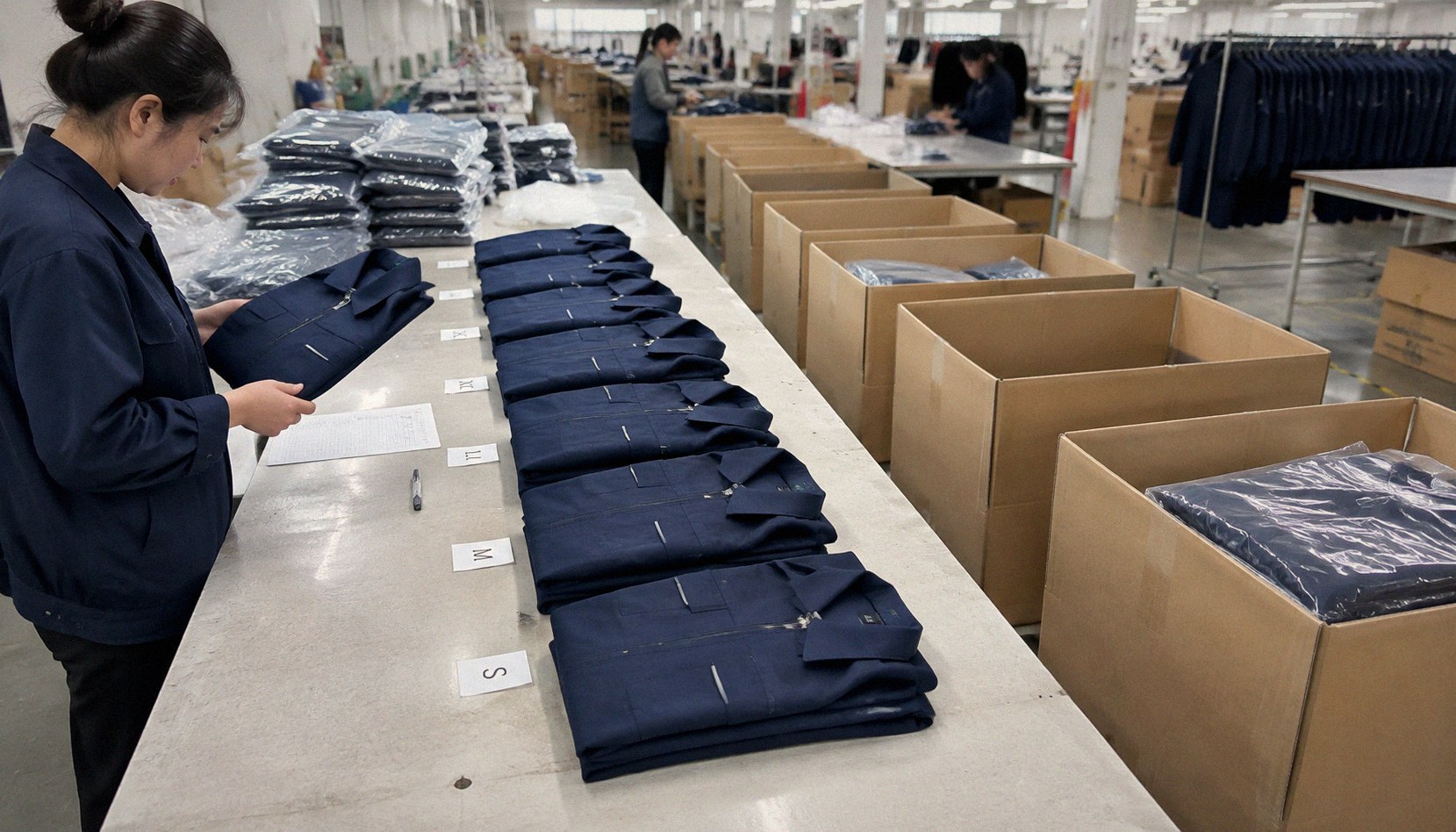
Workshop detail: a graded size set reviewed before bulk cutting, with packing and carton logic confirmed in the same programme.
What to send a uniform manufacturer in your first message
You will get a comparable answer faster if your first message contains:
- The garment types and the departments they are for.
- Approximate quantity and how you expect it to be split by size and colour.
- The wear environment and the laundry method.
- Your branding requirement and its position on each garment.
- Any standard, certification or performance requirement from your market.
- Your target delivery window and the destination.
- A reference garment or photograph, clearly labelled as a reference and not a specification.
Suppliers who work with overseas buyers will normally respond with a specification review, a fabric direction and a sampling proposal rather than a bare price. That response is itself useful evidence about how the programme will run.
Frequently asked questions
How do I compare uniform manufacturers fairly when the quotations differ so much?
Compare the same specification, not the same photograph. Ask each supplier to quote against one written brief with the same fabric direction, construction, branding method, packing and delivery terms, and to state what is excluded. Where quotations still differ, ask which construction or fabric feature explains the difference. A lower figure usually reflects a decision made somewhere in the specification, and you are entitled to know which one.
Should I choose the manufacturer with the lowest MOQ?
Not automatically. A low MOQ reduces your first commitment, but it is only useful if the supplier can also repeat the same fabric, shade and construction on your next order. Ask how the approved fabric and shade are recorded, and what quantity triggers a new dye lot. For a programme with regular replenishment, repeatability is usually worth more than a marginally lower entry quantity.
How do I verify a uniform supplier before placing a bulk order?
Start with documentation and then verify it physically. Request fabric and test evidence for the actual material, a graded size set, an approved sample retained by both sides, and a sample inspection record. Then either visit the factory, request a live remote walkthrough of the relevant lines and QC stations, or use a third-party inspection for the first bulk order. Our Factory page describes how we handle audits and remote walkthroughs, and current certificate and capacity details should always be confirmed from project documents rather than from a marketing page.
Continue the programme
If you are evaluating uniform manufacturers for an upcoming programme, we can review your specification and propose a fabric direction and sampling plan before any volume commitment. Send your brief, size distribution and branding requirement, and we will come back with a structured response rather than a bare quotation.
This guide describes an evaluation framework for uniform procurement. Fabric, certification, MOQ, lead time and performance requirements are project-specific and should be confirmed against your own specification, destination market and current supplier documentation.