Hair Bow Styling for Curly and Textured Hair — A Real Guide
Hair bow styling advice tends to be written with one hair type in mind: straight or gently wavy, medium texture, cooperative enough to go where you point it. If your hair is curly, coily, or textured, most of that advice either doesn’t apply or requires significant translation before it does.
The good news is that bows on curly hair look genuinely beautiful — the contrast between a structured bow and organic curl pattern is one of the strongest visual combinations in hair accessory styling. The practical advice just needs to be specific to the hair type.
The Actual Challenges
Curl shrinkage. Curly hair is significantly shorter when dry than when wet. A styling decision made on wet hair may look different once the curl is fully set. Accessories placed when hair is stretched may sit differently than expected once curls spring back.
Volume and weight. Natural and curly hair often has significant volume, which means scale matters differently than with straight hair. A bow that looks proportional in photos on straight hair may look small on a full-volume curly style.
Grip vs. snagging. Curly hair benefits from accessories that grip without snagging. Clips with exposed teeth or rough hardware can catch on curls and cause breakage. Fabric-covered elastics and accessories with smooth hardware are gentler.
Placement stability. In fine or straight hair, a bow clips to a smooth surface. In textured hair, there’s more surface variation — which can mean better natural grip in some placements, or less predictable behavior in others.
Fabrics That Work Best
Grosgrain is the strongest choice for most curly hair. The ribbed texture grips curl clusters without snagging, and the bow holds its shape even as the hair around it moves and shifts.
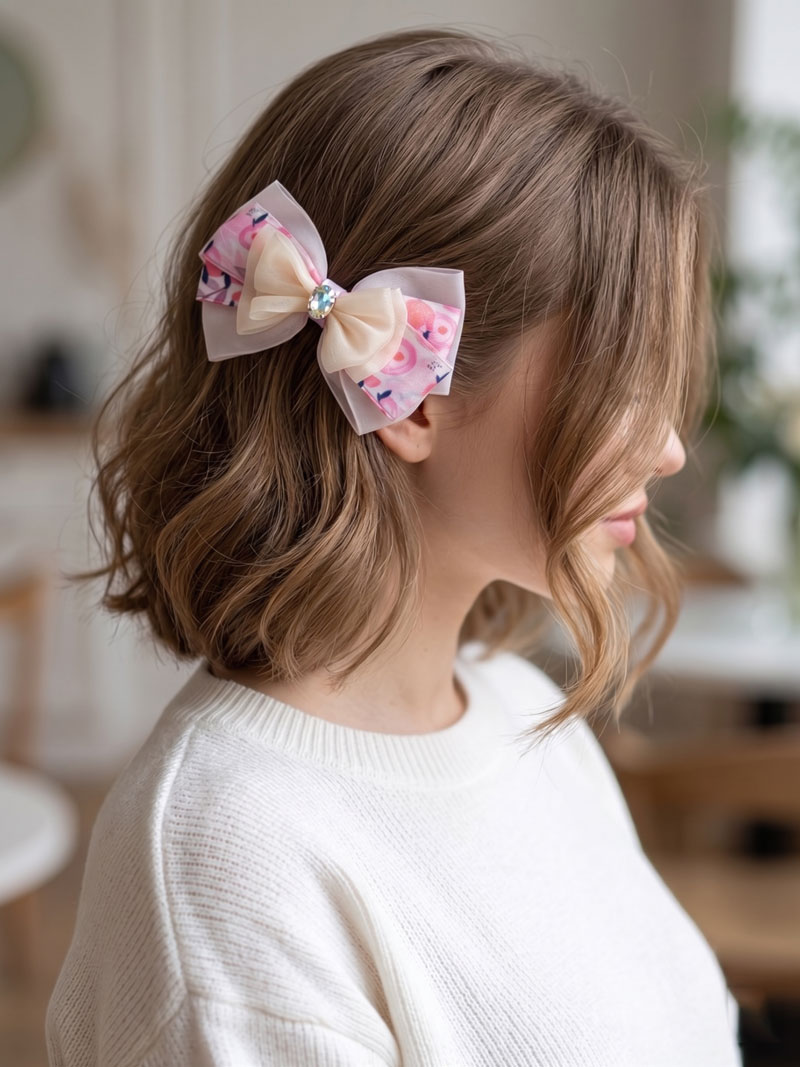
Chiffon and organza work well aesthetically — they complement rather than compete with curl texture — but require a secure attachment underneath (an elastic or clip) to stay in place reliably. Don’t rely on chiffon alone to hold hair.
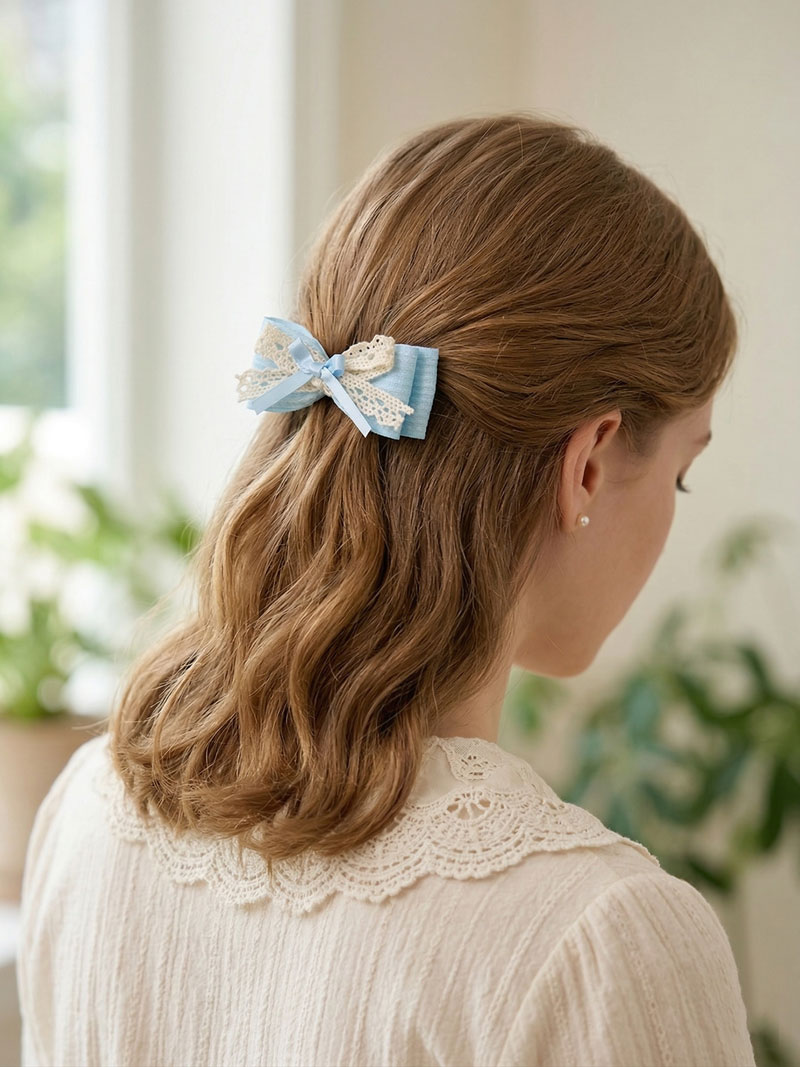
Lace clips are particularly good for textured hair. The structure of the lace means there’s enough material to sit against a curl cluster without requiring a perfectly smooth surface to grip.
Avoid: Smooth satin ribbon as a standalone fastener. The slippery surface doesn’t grip curl texture reliably. Fine for decorative use over a secured section, but not structural.
Placements That Work
The puff bow. Gather your hair into a puff at the crown or mid-head. Tie a wide grosgrain ribbon around the puff — looped through the hair rather than tied on top, so it actually holds — and tie in a bow at the front. This is one of the most visually striking combinations in this whole category: the volume of the puff against the structure of the bow.
The twist section bow. Take a section from the front or side of your hair, twist it back, and pin it. Tie a ribbon over the pin, covering it. The twisted section gives the ribbon a secure anchor point and the resulting look frames the face beautifully.
The end-of-sections bow. On two-strand twists or flat twists, a small ribbon tied at the end of the twist is a simple, effective detail. Use a grosgrain or matte silk — narrow enough to tie around the twist without overwhelming it.
The low nape bow on a puff. If your hair is gathered low at the nape, a bow tied around the gathered section reads beautifully from behind. The curl texture above the bow adds natural visual interest; the bow provides the anchor. This is the most versatile placement for a range of curl types.
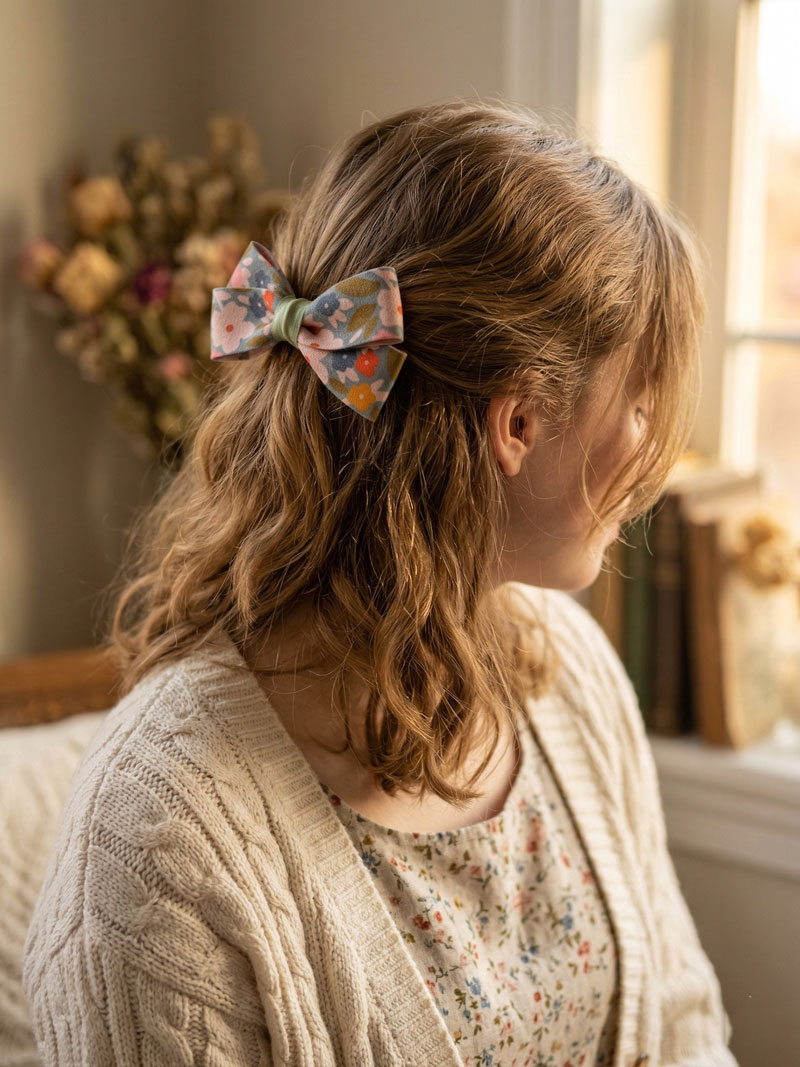
The side clip on loose curls. A lace clip or bow clip placed behind one ear, pulling back a section of loose curls, is a very easy look — no securing underneath, just clip and adjust. Works best with a bow that’s scaled to the curl volume (for big curls, a bigger clip; for fine ringlets, something smaller).
The Scale Question
More so than with straight hair, the scale of the bow matters on curly hair. Here’s the rough guide:
Fine ringlets or small curls: Standard or slightly larger bow. Your hair has volume but each curl is small, so a medium bow (2-3 inch ribbon) reads correctly.
Medium curls or wavy natural hair: A wider bow (3-4 inches) sits better proportionally. The curl volume needs the bow to be visible.
Coarse, high-volume natural hair or large curl pattern: Go bold. A 4-inch or wider grosgrain bow tied around a puff or large gathered section looks right in a way that a small bow simply doesn’t. Don’t be afraid of size here — the hair can carry it.
Protective Styling Considerations
For hair worn in protective styles — braids, twists, locs — hair accessories have a different role:
On braids: A ribbon tied at the ends of individual braids or box braids is a classic accessory choice. Use a grosgrain ribbon that’s narrow enough to tie cleanly around the braid tip. Multiple braid ends can be tied with coordinating ribbons in the same color for a cohesive look.
On locs: A bow clip placed at the side or back works well — you’re pinning to a loc rather than gripping hair, so the hardware quality matters more (smoother is better). A silk scarf tied around a bun of gathered locs is another excellent option.
On twist-outs or braid-outs: The defined curl pattern that results from these styles works with bows exactly as described above for loose natural curls.
A Note on Edges
If you use edge control or gel near your hairline, keep your accessory away from that area — the products can transfer to fabric and cause permanent staining, particularly on lighter-colored ribbons. Apply any products first, let them set, then place the accessory.
[Browse the collection — many of our pieces work particularly well on textured hair →]
Frequently Asked Questions
What type of hair bow works best for curly hair?
Grosgrain ribbon is the strongest choice for curly hair — the ribbed texture grips curl clusters without snagging, and it holds its shape as the hair moves. Lace clips are also effective because they can sit against curl texture without requiring a smooth surface. Avoid smooth polyester satin as a standalone fastener — it doesn’t grip curly hair reliably.
How do you wear a bow in natural hair?
For a puff: tie a wide grosgrain ribbon around the gathered hair, looping it through the hair before tying in a bow at the front. For loose curls: a bow clip placed behind one ear pulls back a section naturally. For braids or twists: a narrow ribbon tied at the end of each section creates a cohesive accessory detail. All of these work best with fabric that has some texture to grip the hair.
Can you wear a hair bow with locs?
Yes. A bow clip placed at the side or back works well on locs — you’re pinning to a loc rather than gripping loose hair, so smooth hardware is important to avoid snagging. A silk scarf tied around a gathered bundle of locs is another excellent option. Avoid very tight elastics or rigid clips that could put pressure on individual locs.
How do you keep a hair bow from slipping in curly hair?
Use grosgrain rather than smooth ribbon, which grips curl texture better. Secure the hair first with an elastic or clip, then tie the ribbon decoratively over it — don’t rely on the ribbon alone to hold the hair. For loose natural styles, lightly fluffing the hair where the bow will sit can create enough surface variation for the ribbon to grip.
What size bow looks good on natural hair?
Scale to your curl volume. Fine ringlets: 2-3 inch ribbon width. Medium curls: 3-4 inches. High-volume natural hair or large curl pattern: 4 inches and wider. The bow needs to be large enough to read against the hair’s natural volume — on voluminous natural hair, a small bow gets visually lost.