Skip to content

The History of the Hair Bow — From Victorian England to Your Drawer

The hair bow is one of those accessories that feels inevitable — so basic, so simple, so obviously right that it seems like it must have always existed. In a sense, it has. But the specific form of the ribbon bow as a hair accessory has a specific history, and understanding it makes the current moment make more sense.

This isn’t a comprehensive fashion history. It’s a focused account of how a length of ribbon tied in a bow came to mean different things across two centuries, and how it arrived at what it means now.


The Ribbon Before the Bow: 18th Century

Ribbons appear in women’s hair throughout the 18th century, but not primarily as bows. The Georgian and Rococo aesthetic favored complex, architecturally tall hairstyles — often powdered and supported by frames — in which ribbons were woven through the hair as decorative elements alongside feathers, flowers, and fabric.

The bow as a specific tied knot in hair was present but not dominant. What we recognize as a hair bow — a ribbon gathered, looped, and tied — became more prominent as hairstyles simplified toward the end of the century and the Neoclassical fashion of the 1790s and early 1800s.


The Victorian Development

The 19th century, and particularly the Victorian period in Britain (1837–1901), is where the ribbon bow as a distinct hair accessory for girls and young women became culturally established.

The association between ribbon bows and girlhood was partly practical: a bow was an easy way to keep long hair out of a child’s face. But it quickly became symbolic. The white or pale ribbon bow in a young girl’s hair became a signifier of innocence, propriety, and proper upbringing — the visible marker of a cared-for child in a culture that was developing strong ideas about childhood as a distinct and protected life stage.

This is also the period in which the association between bows and femininity was strongly established in Western culture. Ribbon bows appeared not just in hair but across dress — as decorative elements on bodices, sleeves, and shoes — as part of a broader visual language of femininity.


The Edwardian Loosening

The Edwardian period (roughly 1900–1910) saw the ribbon bow’s role in women’s hair expand beyond its association with girlhood. As hair styling became more elaborate — with the famous Edwardian "Gibson Girl" silhouette, featuring voluminous hair pinned up in a soft pompadour — large ribbon bows became fashionable for adult women as part of formal hair arrangements.

The Edwardian bow was often substantial: wide ribbon, generous loops, positioned at the crown or side. It was the peak of the bow as a statement accessory in pre-war fashion.


The 20th Century: Retreat and Revival

The First World War accelerated a simplification of women’s dress and hair that was already underway. The 1920s saw short hair and a repudiation of Victorian femininity, including its accessories. The bow retreated — present still, but no longer culturally central.

What’s interesting is the pattern of its revivals. The bow returns reliably at moments when femininity is being rehabilitated after periods of either minimalism or masculine influence: the 1950s post-war new look; the 1980s maximalism; the various cottagecore, coquette, and quiet luxury waves of the 2020s.

The 1950s revival was the bow as emblem of domestic femininity — the housewife’s bow, neat and tidy. The 1980s version was oversized and exuberant — power femininity in excess. The current version is quieter and more materially thoughtful, reflecting the sensibility of the slow fashion movement.


The Japanese Parallel

Running alongside the Western history is a completely independent tradition in Japan. Kanzashi — the Japanese hair ornament tradition — developed its own bow-adjacent forms independently, with bowed ribbon elements appearing in the accessories of the Edo period (1603–1868) and developing alongside the craft traditions of tsumami (silk-folding) and other kanzashi techniques.

This parallel is worth noting because it suggests something about the bow as a form: it keeps emerging independently in cultures that develop refined feminine dress traditions, which implies that the bow’s appeal is at least partly structural — the form itself works, for reasons that may have more to do with visual proportion and material behavior than cultural inheritance.


The Current Moment

The ribbon bow’s current cultural position is unlike any of its previous revivals. It’s not a trend in the strict sense — it’s not been imported from a single source and will not be over by next season. It’s closer to a re-normalization: the bow is being integrated into adult women’s wardrobes as a considered choice rather than a trend adoption.

The driving aesthetics — old money, quiet luxury, cottagecore, coquette — all share an appreciation for things that have a history, that connect to older traditions of careful dress. The bow fits that orientation precisely: it has two hundred years of precedent, it’s simple enough to be timeless, and it can be made well or badly in a way that distinguishes the considered version from the cheap one.

That’s a good position for an accessory to occupy.

[Explore Berkam’s handcrafted collection →]


Frequently Asked Questions

When did hair bows become popular?
Ribbon bows have been part of women’s hair since at least the late 18th century. They became culturally prominent during the Victorian period (1837–1901), when they were strongly associated with femininity and girlhood. They’ve had several major revival periods: the 1950s, the 1980s, and the current 2020s wave, each with a distinct aesthetic character.

Why do people wear hair bows?
Hair bows serve both practical and aesthetic purposes. Practically, they hold hair in place (particularly bow clips) or decorate the point where hair is secured. Aesthetically, they add intentionality and softness to a hairstyle — a considered detail that signals care about one’s appearance. The cultural associations of the bow (femininity, craft, historical precedent) make it a loaded accessory in the best sense.

What do hair bows symbolize?
The cultural meaning of hair bows has shifted across time. In the Victorian period, they symbolized girlhood, innocence, and propriety. In various 20th century contexts, they signified femininity in different registers. In contemporary culture — particularly through the old money and cottagecore aesthetics — they’ve come to suggest craft quality, intentional femininity, and a relationship to historical dress traditions. The symbolism is never fixed; it’s always in context.

Did Victorian women wear hair bows?
Yes, extensively. Victorian girls wore ribbon bows as standard hair accessories, and adult women wore larger, more elaborate bows as part of formal hairstyles — particularly in the Edwardian period that followed. The Victorian era is when the strong cultural association between ribbon bows and femininity was established in Western fashion.

Are hair bows a timeless accessory?
The ribbon bow has shown remarkable persistence across two centuries of fashion change, which suggests it has properties that make it recur independently of trend cycles. Its simplicity, versatility across hair types and styles, and the way it rewards material quality all contribute to this. Whether any individual bow reads as "timeless" depends on the execution — the fabric, the size, the color — but the form itself has consistent cultural staying power.


Shop The Look

Italian Acetate vs. Plastic: Why the Material in Your Hair Clip Actually Matters

"Acetate" appears in more and more hair accessory descriptions as the category has moved upmarket over the past few years. It’s become shorthand for a certain quality level in barrettes, clips, and headbands — the material of the better thing rather than the cheaper one.

But acetate has a complicated identity. There’s plant-derived Italian acetate, which is genuinely different in material composition and behavior from regular plastic. And there’s the word "acetate" applied loosely to various plastic-adjacent materials as a marketing move. Understanding the difference is worth a few minutes, both because you can feel and see the difference in a product, and because the distinction is real.


What Acetate Actually Is

True acetate is derived from cellulose — plant fiber, typically wood pulp or cotton — processed chemically into a polymer. It’s a semi-synthetic material: it starts from a natural origin but undergoes significant processing to become the rigid, colorful sheet material used in accessories.

Italian acetate specifically refers to material produced in Italy, primarily in the Cadore region (near Venice) and in certain facilities in Lombardy, where there’s a long tradition of optical frame manufacturing. The same factories and material processes that produce high-end eyeglass frames produce the acetate used in premium hair accessories — which is why "Italian acetate" has a specific meaning and not just a geographic one.

The production process for high-quality acetate involves layering the material in sheets, mixing colors through the layers rather than surface-treating them, and cutting or milling components from the solid material rather than injection-molding them.


The Key Differences From Regular Plastic

Color depth. Because quality acetate is colored through the material rather than on its surface, the color has depth and variation. Tortoiseshell acetate looks like tortoiseshell — layered, complex, with the color distributed throughout. Injection-molded plastic "tortoiseshell" has a pattern applied to the surface, which looks flat by comparison. The difference is obvious when you hold both next to each other.

Weight. Acetate is denser than most plastics used in accessories. A clip made from genuine Italian acetate feels substantial in the hand — not heavy exactly, but with a quality weight that you notice when you compare it to something hollow or thin. This weight also contributes to how well clips grip: a denser clip has more bite.

Surface finish. Acetate can be polished to a depth of clarity that most plastics can’t achieve. The surface looks almost liquid when polished correctly — light penetrates into it rather than just reflecting off the surface. It also doesn’t have the slight waxy or synthetic quality that many injection-molded plastics have.

Temperature behavior. Acetate is somewhat temperature-sensitive — it becomes slightly more flexible in warmth and more rigid in cold. This is actually a feature in eyeglass frames (it allows for adjustment) and in hair accessories it means the material sits comfortably against the head in a way that rigid plastic sometimes doesn’t.

Durability. Quality acetate doesn’t typically crack or shatter the way brittle plastic does — it tends to bend before it breaks. It also doesn’t fade or discolor the way surface-printed plastics do, because the color is throughout the material.


How to Tell the Difference When Shopping

In person: Hold the piece. Quality acetate has weight. Look at the color from different angles — it should show depth and variation. Check the surface: a polished acetate surface has clarity and light penetration; plastic looks flatter.

Online: Look for specific language. "Italian acetate," "plant-based acetate," "bio-acetate" are meaningful descriptors. Just "acetate" is less clear — technically many plastics have acetate in the name. "Lucite," "acrylic," and "resin" are plastics, not acetate. Price is a rough guide: genuine Italian acetate costs significantly more as a raw material than injection-molded plastic.

The manufacturing tell: Pieces made from acetate sheets show a clear, consistent color throughout the cross-section. A piece made from injection-molded plastic will show the pattern only on the surface.


Why This Matters for Hair Accessories Specifically

Hair accessories sit near your face for hours at a time. The material quality is visible at close range in a way it isn’t for items worn at a distance. A beautiful tortoiseshell barrette in genuine Italian acetate looks like a considered object. The same shape in printed plastic looks like what it is.

There’s also a skin-contact consideration. Genuine acetate is plant-derived and hypoallergenic — it doesn’t contain the plasticizers that some conventional plastics do, which can cause reactions in sensitive skin.

At Berkam, we use Italian acetate in our clip hardware for exactly these reasons. It’s more expensive as a raw material and requires more careful machining and finishing. The result is a clip that looks, weighs, and performs the way an accessory that’s near your face for hours should.

[Explore our collection — hardware that wears as well as it looks →]


Frequently Asked Questions

What is Italian acetate in hair accessories?
Italian acetate is a semi-synthetic material derived from cellulose (plant fiber), produced primarily in Italy’s optical-frame manufacturing tradition. It’s colored through the material rather than on the surface, polished to a depth of clarity that most plastics can’t achieve, and is denser and more durable than injection-molded plastic. The difference is visible and palpable in person.

Is acetate better than plastic for hair clips?
Genuine acetate — particularly Italian plant-derived acetate — is better than conventional plastic in most meaningful ways for hair accessories: it has deeper color, better surface polish, more substantial feel, is hypoallergenic, and ages more gracefully. The tradeoff is cost: quality acetate costs significantly more than plastic, which is reflected in the price of accessories made from it.

How can you tell if a hair accessory is real acetate?
In person: check the weight (acetate is denser than most plastics), look at the color from different angles (it should show depth throughout the material, not just on the surface), and check the surface finish (quality acetate has a clarity and light penetration that plastic doesn’t). The cross-section of a cut edge will show consistent color throughout if it’s genuine acetate.

Is acetate safe for sensitive skin?
Yes. Genuine cellulose acetate is plant-derived and hypoallergenic — it doesn’t contain the plasticizers and chemical additives found in some conventional plastics that can cause skin reactions. This is one reason it’s widely used in eyeglass frames, which also have extended skin contact.

Why is Italian acetate more expensive?
The production process is more involved than injection molding: color is integrated through layered sheet production rather than surface treatment, components are cut or milled from solid material rather than molded, and the material itself has a more expensive raw material input (cellulose rather than petroleum-derived polymers). The optical-frame industry’s Italian acetate facilities have invested generations in refining this process, which is reflected in material cost.


Shop The Look

What Is Kanzashi Silk? The Japanese Art Behind Our Heritage Pieces

Most people encounter kanzashi without knowing the name. You’ve probably seen the flowers — tiny, perfectly geometric blooms made from folded silk squares, arranged into complex compositions. They’re the kind of object that looks impossible until you understand the process, and then looks even more impressive.

Kanzashi (かんざし) is the Japanese word for hair ornament, but it’s also the name for a specific tradition of silk-folding that has produced some of the most technically precise decorative objects in the world. It’s been part of Japanese court culture since at least the Heian period (794–1185), and it’s still practiced today, both in traditional contexts and as a contemporary craft.

At Berkam, our heritage silk pieces use Japanese kanzashi silk specifically because of the properties that tradition has optimized over centuries.


How Kanzashi Is Made

Traditional kanzashi flowers are built from small squares of habutai or chirimen silk, each folded into precise petal shapes using one of two methods:

Tsumami kanzashi — "pinched" kanzashi. Small squares of silk are pinched into petal shapes using tweezers, then arranged and glued (traditionally with rice starch paste) onto a base. The petals are typically round (maru-tsumami) or pointed (kaku-tsumami), and the combinations of these shapes produce dozens of different flower forms. A single complex kanzashi piece may contain hundreds of individually pinched petals.

Chirimen kanzashi — uses a crinkled, textured silk that creates a slightly different visual character. The crepe texture of chirimen gives the petals a softer, more dimensional quality than the smoother habutai.

The silk used in traditional kanzashi is selected specifically for its behavior when folded: it holds a crease without springing back, takes dye evenly, and has a sheen that makes even small petals read distinctly at a distance. Generic silk ribbon doesn’t behave the same way — the weave and weight are optimized for different purposes.


The Cultural Context

Kanzashi were part of the visual language of Japanese women’s dress for over a millennium. Different styles, flowers, and arrangements were associated with different seasons, social positions, and occasions. A maiko (apprentice geisha) in Kyoto still wears seasonal kanzashi as part of her formal dress, with the specific flowers changing each month to reflect the natural world outside.

This is worth knowing not as trivia but as context for why the craft survived: it wasn’t decorative in a frivolous sense, it was communicative. The object carried information about the wearer and her moment in the world. That kind of intentionality tends to produce lasting craft traditions.


Why Kanzashi Silk Behaves Differently in Hair Accessories

When we describe our heritage pieces as using Japanese kanzashi silk, we mean specifically that the silk has been selected, woven, and finished for the demands of this tradition — not just that it’s Japanese silk.

The differences in practice:

Crease retention. Kanzashi silk holds folded shapes without internal structure or stiffening agents. This is why a silk flower petal made from kanzashi silk keeps its shape through humidity, heat, and handling — properties that are less reliable in general-purpose silk ribbon.

Color saturation. Traditional kanzashi silk takes dye at high saturation levels while maintaining the fabric’s natural luminosity. This produces colors that are intense without being flat — you can see the depth of the color rather than just its surface.

Weight and hand. Kanzashi silk has a specific weight that makes it behave well at the small scales involved in hairpiece construction. Too heavy and small petals distort; too light and they lose definition. The tradition has optimized for this over centuries.

These properties matter less for bow shapes (where any good silk ribbon does reasonable work) and more for the shaped, sculptural elements — the flower clusters, the layered petal arrangements — where precision in the material is directly visible in the finished piece.


The Berkam Connection

We source our kanzashi silk from Japanese suppliers who work with the traditional mills that have served this craft for generations. It’s more expensive and more difficult to source than generic silk alternatives. The finished pieces take significantly longer to construct than bow shapes made from ribbon.

The reason we use it is the same reason we use French grosgrain for our ribbon bows: the material quality is visible in the finished piece, and in objects worn this close to your face and hair, that visibility matters.

Our heritage silk pieces are made in smaller quantities than our ribbon bows — the production time simply doesn’t allow for the same batch sizes. When they’re in stock, it’s because someone spent considerably more time on them than on a grosgrain bow, and the pricing reflects that.

[Explore our heritage silk collection →]


Frequently Asked Questions

What is kanzashi?
Kanzashi is a traditional Japanese art form of making hair ornaments from folded silk. The word refers both to Japanese hair accessories generally and to a specific technique of folding small silk squares into precise petal shapes. The practice has been part of Japanese culture since at least the Heian period (794–1185) and continues in both traditional and contemporary contexts.

What silk is used in kanzashi?
Traditional kanzashi uses habutai silk (a smooth, lightweight plain-weave silk) or chirimen silk (a crinkled crepe silk) selected specifically for its behavior when folded. Kanzashi silk holds creases without springing back, takes dye at high saturation, and has appropriate weight for small-scale construction. Generic silk ribbon is woven for different purposes and doesn’t perform the same way.

How long does it take to make a kanzashi hair accessory?
A simple kanzashi flower with a dozen petals takes an experienced maker around 30–45 minutes. Complex multi-flower compositions with hundreds of individual petals can take many hours or days. This is why traditional kanzashi pieces are significantly more expensive than equivalent-looking accessories made with other techniques — the time investment per piece is substantial.

Are kanzashi hair accessories suitable for everyday wear?
Yes, with some care. Kanzashi silk pieces are more delicate than grosgrain or plain silk ribbon bows and benefit from gentle handling. They’re well-suited to occasions, special events, or days when you’re not doing anything that would put the piece at risk of being snagged or crushed. For truly everyday wear, a grosgrain or plain silk bow is more practical.

What is the difference between kanzashi and regular silk hair accessories?
The key difference is construction method and material selection. Regular silk hair accessories are typically made from ribbon — a flat, woven strip. Kanzashi pieces are built from individually folded fabric squares, creating three-dimensional sculptural shapes. The silk used is also specifically selected for kanzashi properties, not general textile use. The result is a fundamentally different visual and tactile character.


Shop The Look

How to Care for Lace Hair Accessories — Making Them Last for Years

Lace is the one material in the hair accessory world that most people either over-wash (and ruin) or never wash at all (and watch quietly degrade). Neither approach serves you well, especially when the lace in question is on something you wear near your face regularly.

The good news: caring for lace properly is not complicated. It’s mostly about knowing what to avoid, because lace is more vulnerable to the wrong treatment than to reasonable neglect.


Why Lace Needs Different Treatment

Lace — whether cotton Chantilly, nylon, or the embroidered varieties used in hair accessories — is a net structure. The pattern is created by the deliberate arrangement of threads around open spaces, and that structure is what gives lace its visual delicacy. But those open spaces also mean there’s less material holding each thread in place.

Applied force — rubbing, wringing, machine washing — doesn’t wash lace, it distorts it. The threads shift. The pattern loses its crispness. Once the net structure is disturbed, you can’t iron it back into shape without specialized equipment.

Hair accessories add a layer of complexity because lace is often combined with other materials: a ribbon backing, fabric-covered hardware, crystal or bead embellishments. Each of those materials has its own care requirements, and the treatment for lace may conflict with what’s ideal for the hardware.

The starting rule: always care for a lace accessory at the level of its most delicate component.


Cleaning: What Actually Works

For light soil and everyday wear: A barely damp cloth, gently blotted (never rubbed) against the lace surface. This handles most of the dust and surface debris that accumulates with regular wear. Let air dry completely before storing.

For product buildup or more significant soiling: A shallow basin of cool water with a very small amount of gentle lingerie detergent or baby shampoo. Submerge the lace piece, agitate the water gently with your hand rather than handling the lace directly, then lift it out without wringing. Support the piece fully as you move it — never dangle lace from one point, which stresses the net structure at that point.

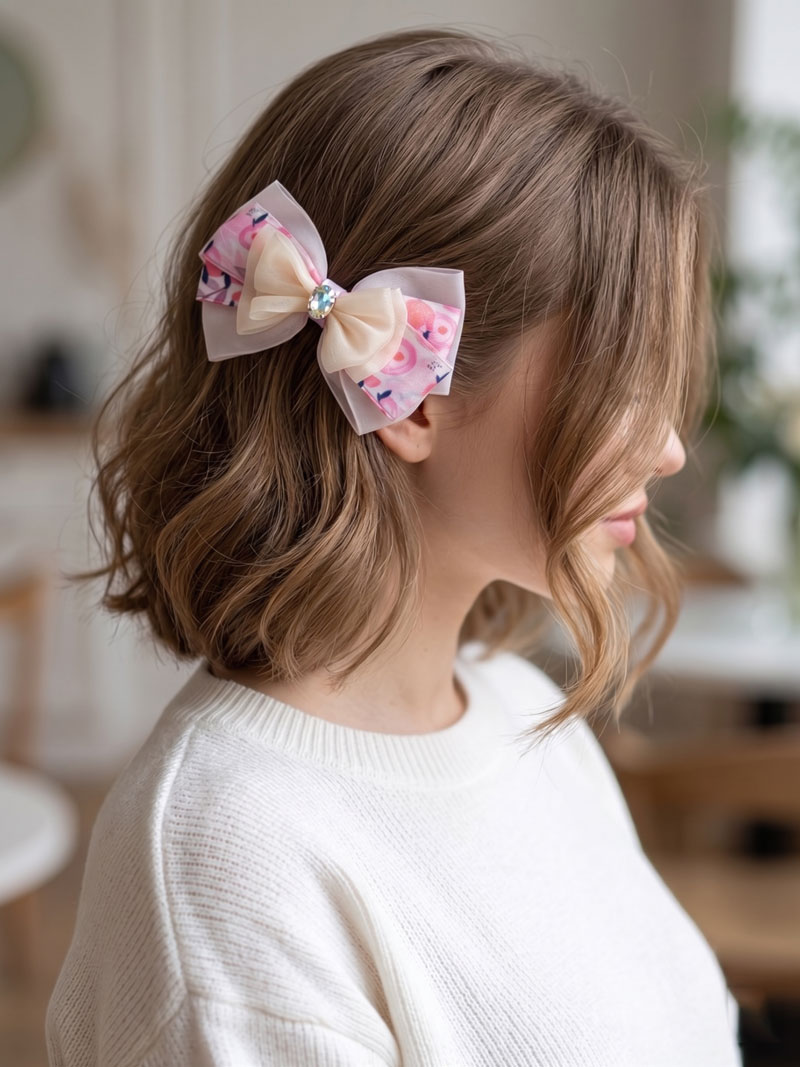
For crystal or bead embellishments (like those on the Floral Crystal Butterfly Bow or Confetti Dot Crystal Bow): keep the embellishment area out of the water if possible. Crystals on hair accessories are typically heat-set or glued, and extended water exposure can weaken the setting. Clean the lace body, avoid the crystals.

What not to do: No rubbing, no wringing, no machine washing, no soaking for extended periods, no warm or hot water.


Drying: The Step That Matters Most

Lace should never be hung to dry. Gravity pulls the water downward through the net structure and creates uneven tension that permanently distorts the pattern.

The correct method: after gently removing excess water by pressing the lace flat between two clean dry towels (don’t twist), lay the piece flat on a fresh dry towel or a mesh drying surface. Gently reshape by hand while the lace is still damp — ease the edges back to their correct shape, make sure any bow loops are positioned correctly. Let dry completely at room temperature, away from direct sunlight.

Direct sunlight is worth specifically avoiding with lace. UV exposure degrades natural fibers faster than almost any other factor, and with white or ivory lace, it creates that yellowing that’s very difficult to reverse.


Reshaping

If lace has lost its shape — particularly bow loops that have gone flat, or edges that have curled — the gentlest way to restore them is steam, not an iron.

Hold a garment steamer (or a kettle at a careful distance) near the piece without touching it, let the steam work into the lace for a few seconds, then gently ease the shape back with your fingers and hold until cool. This is significantly safer than applying an iron directly, which can melt synthetic lace or crush the net structure.

If you need to press lace flat (for a flat element of the accessory rather than bow loops), place several layers of clean white cloth over the lace and apply a barely-warm iron. Never apply an iron directly to lace.


Storage

Lace shouldn’t be compressed or folded in storage — the pressure flattens the net structure and creates creases that are difficult to remove.

For individual pieces: lay flat in a shallow drawer or box, ideally in a single layer. If you need to stack pieces, place a layer of acid-free tissue between each one.

For bow-shaped accessories: store with the loops shaped correctly. A small amount of tissue paper inside the loops keeps them round during storage and prevents them from collapsing under their own weight.

Keep stored lace away from light and humidity. Both accelerate fiber degradation. A fabric bag (not a plastic one, which traps moisture) in a dark drawer is ideal.


The Berkam Lace Pieces: Specific Notes

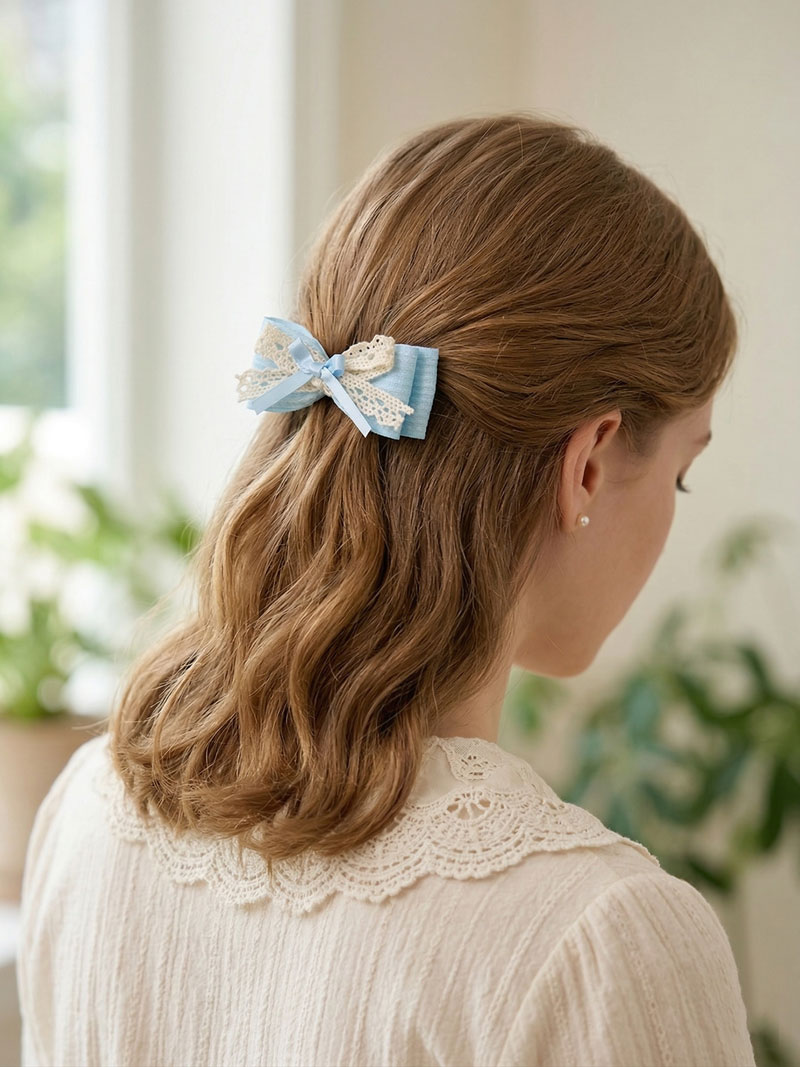
The Baby Blue Lace & Ribbon Bow and Golden Bird Lace Bow in our current collection use a woven lace that has good structural integrity — it’s not the delicate Chantilly variety that needs museum-level care. That said, all the principles above apply: cool water, no rubbing, flat drying, shaped storage.

The crystal pieces (Confetti Dot, Floral Crystal Butterfly, Rosy Bloom) have heat-set crystals that are robust under normal wear but benefit from keeping the crystal areas out of water during cleaning. The organza and chiffon bows (Blushing Rose, Lilac Rose) need the same flat-drying treatment as lace.

If you’re unsure about cleaning a specific piece, the safest default is a barely-damp cloth for surface cleaning and otherwise keeping the piece dry. Most light soil in regular wear is surface-level and responds to this.

[See our current lace bow collection →]


Frequently Asked Questions

How do you wash a lace hair bow?
Hand wash only, in cool water with a small amount of gentle detergent. Submerge and agitate the water gently rather than handling the lace directly. Never rub, wring, or machine wash. Rinse thoroughly, press between dry towels to remove excess water, then lay flat to dry completely.

Can you iron a lace hair accessory?
Not directly. If pressing is needed, place several layers of clean white cloth over the lace and apply a barely-warm iron — never iron lace directly, which can melt synthetic fibers or crush the net structure. Steam is generally safer than direct pressing for restoring shape to lace bow loops.

How do you stop lace from yellowing?
Keep lace away from direct sunlight and UV exposure, which is the primary cause of yellowing in natural and synthetic fibers. Store in a fabric bag in a dark drawer rather than in open storage. For white or ivory lace that has already yellowed slightly, specialist textile cleaning is the only reliable remedy.

How should you store lace hair accessories?
Lay flat in a shallow drawer or box, not folded or compressed. If storing bow shapes, place a small amount of tissue paper inside the loops to keep them round. Avoid plastic storage containers (which trap moisture) and keep away from direct light. Acid-free tissue between layered pieces prevents transfer and compression damage.

How long do lace hair accessories last if properly cared for?
A well-made lace hair accessory from quality materials, properly cared for, should remain in good condition for many years — potentially decades if stored well. The main failure modes are fiber degradation from UV exposure, structural distortion from improper washing, and hardware failure. If all three are managed, the lace itself is surprisingly durable.


Shop The Look

How We Choose Our Ribbons — The Criteria Behind Every Berkam Bow

People occasionally ask how we source our ribbons — usually fellow makers looking for suppliers, or customers who notice that a Berkam bow behaves differently from others they’ve owned. The answer always comes back to the same thing: a set of standards we’ve refined over time by handling a lot of ribbon that didn’t make the cut.

The Hand Test

Before anything else, you pick up the ribbon and feel it. It’s not scientific, but it tells you plenty.

What we want: body without stiffness. Hold a length horizontally — it should resist drooping and stay roughly level, but never feel rigid or papery. Ribbon that droops right away has no structure and makes a bow that collapses within hours. Stiff ribbon ties neatly but doesn’t drape naturally.

Thread Count and Weave

With woven ribbons, the density of the weave speaks directly to durability and behavior.

Low thread-count grosgrain shows gaps between the ribs, feels too light, and frays easily at the edges. Higher thread-count grosgrain has tight ribs, a dense handfeel, and holds its edge after cutting and sealing.

For silk, we look for true woven silk — not printed or coated versions. Hold it up to light, and you should see the thread structure.

The Color Test

We dye some of our own ribbon, but more often we source pre-dyed options — so we have to check that the color is properly set.

The test: dampen a small piece and press it against white cloth or tissue. If a lot of color transfers, the dye isn’t fixed and will run from rain, sweat, or humidity. Good ribbon might release a tiny bit of dye (they all do), but not enough to show up on hair.

Edge Behavior

Before we approve a new ribbon for production, we cut a short length, heat-seal the ends, and handle it repeatedly to see how it wears.

Good ribbon: the heat seal is clean and even. The edge stays sealed — no peeling, cracking, or discoloration.

Poor ribbon: the seal is uneven, the edge still frays, or heat causes color change.

What We Reject, and Why

Lightweight polyester that mimics silk: Looks similar in photos, performs completely differently. No body, too shiny, frays instantly, and slips in hair.

Ribbon with uneven dye lots: We test every batch against previous stock. Inconsistent dye lots mean bows from the same colorway don’t actually match.

Ribbon with surface coatings: Some manufacturers add a coating for better feel or shine. It wears off quickly and leaves an uneven, patchy finish.

Anything that feels cheap: There’s a flat, hollow quality to cheap ribbon that stands in sharp contrast to material with actual substance. We’ve handled enough to know it on touch.

[Browse what we’re working with this season →]

Frequently Asked Questions

What makes ribbon good for hair bows?
Good bow ribbon has body (so it holds shape instead of drooping), grip (so it stays tied, especially in fine hair), and durable edges (so it doesn’t fray). These come from weave density, fiber type, and construction — things you can feel before you even start making.

How do you test ribbon quality for hair accessories?
Hold a length horizontally — good ribbon resists drooping; bad ribbon sags right away. Press a damp piece against white cloth — heavy dye transfer means the color isn’t set. Heat-seal an end and handle it — a good seal stays intact without cracking or peeling.

What is the difference between cheap and quality grosgrain?
Quality grosgrain has tight, fine ribs, a dense weave, and actual weight — it feels solid. Cheap grosgrain has wider ribs, feels light, and sometimes has a plasticky coating. You can see the difference held up to light, and feel it in your hands.

Why does ribbon color consistency matter?
Accessories from the same color family should look consistent when worn together or compared. Inconsistent dye lots mean two rolls of the “same” color can look noticeably different. We test each new delivery against existing stock.

Does ribbon origin affect hair bow quality?
With French silk, yes. Mills in the Lyon region have woven silk for centuries, producing ribbon with a particular weight, drape, and sheen. For grosgrain, origin matters less — quality comes down to the mill’s standards, not its location.


Shop The Look

A Week Inside the Berkam Studio — What Making Things Slowly Actually Looks Like

Most brand "behind the scenes" content feels like a performance. The perfectly lit workspace, the photogenic pile of ribbons, hands that never actually look like they’ve been working. We’ve all seen enough of it to recognize the formula.

This is something different: a reasonably honest account of what a week of small-batch production actually looks like, including the parts that aren’t especially picturesque.


Monday: Materials and Planning

The week begins with inventory. Not a romantic process — it’s a spreadsheet and counting what’s left on the ribbon spools. We typically work with about a dozen core fabrics: two or three weights of grosgrain in our main neutral palette, two silk weights, and whatever seasonal accent we’ve brought in.

Monday’s question is always the same: what do we have enough of to make a full run this week, and what needs ordering? Ribbon arrives from our French suppliers in relatively small quantities — we’re not buying by the kilometer. This is intentional, but it means planning ahead is essential.

By mid-morning we’ve settled on the week’s production: a run of low ponytail bows in grosgrain (black and ivory), and a smaller batch of French silk bows in the sage that’s been selling quickly. Plus a handful of custom orders, including one bride who wanted a specific ivory with a slightly wider center knot than our standard.


Tuesday: Cutting

Cutting day. Ribbon gets measured and cut to length before any tying begins, because consistent lengths are what give the finished bows their proportions. We use a cutting board and steel rule — about as low-tech as it sounds.

The less-romantic reality: cutting 40 pieces of ribbon at consistent lengths takes time, and it’s one of those tasks where your attention has to stay focused, or the variations add up.

We heat-seal the ends immediately after cutting. A ribbon burner — a small tool with a heated element — melts the cut edge just enough to prevent fraying. Silk requires a lighter touch than grosgrain; too much heat and you get discoloration at the edge.


Wednesday: Tying

The actual bow-tying begins. Each bow needs consistent loop size, knot tension, and trailing end length. When you’re tying twenty bows from the same ribbon, muscle memory helps, but your attention still has to stay on the work.

We check each bow against a reference piece before it moves to the next stage. Not because every bow needs to be mechanically identical, but because there’s a difference between natural variation and careless inconsistency.


Thursday: Hardware and Assembly

The bows get attached to their hardware — barrette clips, alligator clips, or left as free ribbon. We use brass fittings, which cost more than the silver-plated zinc alloy in most mass-market accessories. The difference isn’t just aesthetic: brass is denser, doesn’t snag fine hair, and ages in a way that looks intentional rather than worn.

Thursday also means photographing finished pieces. Natural light, a clean surface, minimal editing. We want the photos to show what the fabric actually looks like.


Friday: Quality Check and Packing

Everything gets laid out and inspected before anything enters stock. We’re looking for consistent loop size, clean edge sealing, secure center wrap, smooth-functioning hardware, and matching end lengths.

This is also when anything that doesn’t meet our standards gets set aside. It doesn’t happen often — maybe two or three pieces from a run of forty — but it happens, and those pieces don’t go out.

Custom orders get packed individually, with a card and care note. Nothing elaborate, but enough that opening the package feels like receiving something prepared specifically for you.

[See what came out of this week →]


Frequently Asked Questions

How are Berkam hair bows made?
Each bow is hand-assembled in small batches. Ribbon is measured, cut, and edge-sealed individually. Bows are hand-tied rather than machine-formed, then attached to brass hardware with a center wrap that covers the attachment point. Every bow gets checked against a reference piece before it enters stock or ships.

How long does it take to make a handmade hair bow?
From cutting ribbon to finishing hardware attachment, a single bow takes about 8–12 minutes depending on the style. In a batch of 30–40 bows, the time per piece decreases as the maker finds their rhythm — but individual quality checks mean you can’t rush the process without sacrificing consistency.

What makes small batch hair accessory production different from factory production?
In small-batch production, every piece gets individual inspection rather than statistical sampling. The maker checks knot tension, edge seal quality, loop symmetry, and hardware function on each bow — not one in twenty. It’s slower and more expensive per unit, but produces more consistent quality.

Why does Berkam use French ribbon?
French silk ribbon from the Lyon mills has a specific weight, weave density, and drape that creates better-behaved bows than synthetic alternatives or generic silk ribbon. It holds its shape, drapes naturally when tied, and avoids the plastic-like quality of cheaper ribbon.

How do you check quality in handmade hair bows?
Each bow gets compared against a reference piece from the same run. We also inspect edge seals for completeness, test hardware function, and check the center wrap’s position and tension. Pieces that don’t meet our standards get remade.


Shop The Look

French Silk vs Satin vs Grosgrain — An Honest Guide to Hair Bow Fabrics

When you’re shopping for a hair bow and you see "satin ribbon bow" listed at $8, and a "French silk bow" listed at $38, it’s reasonable to wonder whether the difference is the fabric or just the story around the fabric.

It’s mostly the fabric. Here’s what’s actually different between the three materials you’ll encounter most, what each does well, and how to match the fabric to how you actually wear your hair.


Satin: The Most Common, the Most Misunderstood

Satin is a weave structure, not a raw material — a point that gets glossed over in almost every product description. "Satin" describes how the threads are arranged to produce a smooth, high-sheen surface, and it can be made from polyester, nylon, silk, or various blends. The satin you find in most mass-market hair accessories is polyester satin, and it behaves very differently from silk satin.

Polyester satin has a pronounced shine that can look plastic in certain lights. It’s quite lightweight, which means it’s easy to handle and photograph well, but it also means the bow doesn’t have much body — it tends to flatten over time and slips against the hair more than heavier fabrics. The edges, unless heat-sealed very carefully, fray quickly.

The upside: it’s inexpensive, widely available in a huge range of colors, and works well for short-term wear or occasional use.

Silk satin is a different experience entirely. The sheen is still there but it’s softer, warmer, and changes depending on the angle of the light. The fabric has genuine weight and drape. It holds a bow shape more naturally, doesn’t slip, and the edges can be finished in ways that last for years. It also has that particular quality of silk: it’s warm against the skin and doesn’t cause the small frictions that synthetic fabrics do.

If a bow is labeled "satin" without specifying the content, assume polyester. Silk satin will almost always be specified — it’s a selling point.


Grosgrain: The Workhorse

Grosgrain is a ribbed, matte ribbon with a firm, substantial feel. The defining quality is its texture: the visible horizontal ribs give it grip, which means grosgrain stays tied and holds a bow shape better than almost any other fabric. If you’ve ever had a bow work loose over the course of a day, it was probably not grosgrain.

It’s not the most glamorous option — grosgrain is workmanlike in the best sense — but it has qualities that suit a lot of everyday wearing. It looks good in neutrals. It photographs cleanly. It ages well without becoming shiny or pilling. And because it has real structure, grosgrain bows tend to stay readable (meaning: they don’t droop or collapse) even after hours of wear.

High-quality grosgrain ribbon is heavier and has finer, denser ribs. Cheap grosgrain is lighter with more widely spaced ribs and a slightly plasticky finish. The difference is visible when you hold a ribbon to the light.

Best for: Everyday wear, office settings, any style that benefits from a bow that holds its shape reliably. The neutral-toned grosgrain bow on a low ponytail is the most wearable iteration of this accessory category.


French Silk: The Best-Behaved Option

"French silk" isn’t a technical classification so much as a description of origin and quality level. It refers to woven silk fabric sourced from the established silk mills in France and the Lyon region specifically, which has a several-hundred-year history of producing some of the best woven silks in the world.

What makes it different from generic silk ribbon: the weave is typically finer and the threads higher-quality, which produces a fabric that has weight without being stiff, sheen without being plasticky, and a quality of movement that’s hard to describe but immediately noticeable. When you tie a bow from French silk ribbon, it drapes. The loops settle naturally into something that looks considered even if you tied it in ten seconds.

It’s also more durable than you’d expect from something so light. The weave density means it doesn’t snag easily, and the edges — when properly finished — hold up to regular use.

The cost is real: French silk ribbon is significantly more expensive per meter than polyester satin or even generic silk ribbon. Which is why you’ll find it primarily in smaller-production accessories, where the economics allow for better materials at the per-unit level.

Best for: Occasion wear, weddings, any context where the bow is clearly the focal point of the look. Also particularly good for fine hair — the weight and drape mean the bow sits correctly without your hair having to support a stiff ribbon structure.


A Quick Comparison

Satin (poly) Grosgrain French silk
Texture High sheen, smooth Matte, ribbed Soft sheen, draped
Body Light Medium–firm Medium, fluid
Grip Low (slips) High (holds) Medium
Durability Low–medium High High
Best setting Casual, occasional Everyday, office Occasion, fine hair
Maintenance Low Low Gentle hand wash

How to Choose

There isn’t a universally correct answer — it depends on what you’re making the bow do.

For something you’ll wear most days: Grosgrain. It’s forgiving, it stays put, and a good grosgrain bow in a neutral color goes with most things.

For a special occasion: French silk, if the budget allows. The drape and the way it photographs are genuinely different from alternatives.

For color and variety on a lower budget: Polyester satin is a reasonable choice if you’re experimenting with colors or styles before committing to better materials. Just be aware of its limitations.

For fine or slippery hair: French silk or grosgrain over satin. The texture of both fabrics means they hold better than smooth satin, which can slide out of place throughout the day.

At Berkam, we work primarily with French silk and woven grosgrain — these are the two fabrics that justify the care we put into the construction. Polyester satin is widely available elsewhere; we’re not trying to compete on that.

[Browse our current collection →]


Shop The Look

What Actually Makes a Hair Bow “Handmade”? (And Why It Matters)

The word "handmade" is on a lot of tags right now. Etsy listings, Instagram captions, small brand websites — it’s become a default descriptor, which has made it almost meaningless. You can buy a "handmade" hair bow from a dropshipping store and a "handmade" hair bow from someone who spent forty minutes on that specific piece. Both use the same word.

So what does it actually mean? And does the distinction matter in any practical way — in how the bow looks, how it behaves in your hair, how long it lasts?

The short answer: yes, quite a lot. Here’s what to look for.


What "Handmade" Actually Covers

When a bow is genuinely handmade, the production process involves human hands at every meaningful stage: cutting the ribbon, tying or folding the bow, securing the center knot, and attaching the hardware. There’s no mold involved, no automated folding mechanism, no machine that presses a pre-cut ribbon into a standard shape.

This matters for a few concrete reasons.

First, the bow is tied rather than formed. A hand-tied bow has slight natural variation — the tension isn’t perfectly even, the loops aren’t identical. That slight imperfection is actually what gives a bow its relaxed, organic quality. A machine-formed bow is too symmetrical. It reads as flat, slightly plastic in appearance even when the material is good.

Second, the cut edges are often finished by hand — either heat-sealed or hand-fray-sealed. This is the difference between a ribbon that frays after three wears and one that holds its edge for years.

Third, the attachment point — where the bow meets the clip or barrette — is usually secured more carefully, because a person is checking the tension and finish as they go. Machine-made bows often have attachment points that are technically secure but feel flimsy if you tug them with any purpose.


The Materials Question

Genuine handmade production almost always involves better materials, not because the maker is morally superior but because the economics work differently. When you’re producing at scale, you buy materials at volume and accept tradeoffs. When you’re making in small batches, you buy less of something better, because your margin per piece is higher and your reputation depends on the quality of each individual item.

In practice, this means the difference between:

Ribbon quality. Factory-grade satin ribbon has a slight plasticky sheen and is often quite lightweight — it looks good in a photograph but lies flat in the hair rather than draping. A properly woven grosgrain or a real woven silk has actual body, which means the bow holds its shape and moves naturally rather than flopping.

Hardware. Stamped brass barrettes and clips age well and don’t snag. Thin-plated findings look fine initially but the plating wears through — often within a few months — and the exposed metal can tangle in fine hair.

Linings and inner construction. A well-made bow that you’d wear to, say, a wedding, has a small inner support — either a piece of the same ribbon or a small strip of stiffened fabric — that keeps the loops from collapsing. Cheaper construction skips this and the bow gradually wilts.


How to Tell the Difference When Shopping

You can’t always handle something before you buy it, especially online. But there are reliable ways to read a product listing.

Look at the photos carefully. A genuinely handmade bow photographed at close range will show the texture of the ribbon — the weave, the slight variation in the knot, the way the fabric catches light at different angles. Heavily edited product photos that flatten texture are a bad sign.

Read the description for specifics. Vague descriptions ("beautiful handmade bow!") tell you nothing. Meaningful descriptions give you information: the ribbon width, the fabric type, the barrette width, how the bow is finished. If the maker can’t or won’t describe the construction, that’s worth noting.

Look at the scale of the operation. If someone is selling 200 units a week of the same bow in 30 colorways, at least some of that production is automated or outsourced. That’s not necessarily bad — but it isn’t handmade in the full sense of the word. Small-batch makers typically sell limited quantities, often note when things are out of stock, and have longer production times for custom orders.

Price is a rough indicator, not a reliable one. Truly handmade items take time. If a bow is priced at the same level as a fast-fashion accessory, the economics don’t add up for genuine hand production. That said, price alone doesn’t guarantee quality — some brands charge premium prices for very average construction.


What We Do Differently at Berkam

At Berkam, every bow is hand-assembled in small batches. That means we cut our ribbons to length, tie each bow individually, finish the edges by hand, and attach the hardware with enough care that we’d notice if something was off.

The ribbons we use are sourced from European suppliers — French silk and woven grosgrain that have actual weight and structure. The hardware is brass. We don’t pre-tie and stockpile hundreds of bows waiting for orders; we make what we know we can sell, which keeps the quality consistent across every piece.

We started doing it this way because our founder spent years collecting antique hair accessories — the kind of pieces that are sixty, seventy years old and still hold their shape. That kind of longevity comes from genuine material and genuine construction. There’s no shortcut that replicates it.

[See the bows we’re making right now →]


Does Any of This Actually Matter?

If you’re buying a bow to wear once or twice, probably not. Mass-produced accessories serve that purpose fine.

But if you’re building a collection of things you actually reach for — the pieces you wear because they feel right, and that still look good two years from now — then the distinction is real. A handmade bow, made from proper ribbon and finished carefully, is going to outlast several of its factory-made equivalents. It’s going to hold its shape. And it’s going to look like something chosen rather than just added.

That’s what "handmade" is supposed to mean. When it does, it’s worth the difference.


Want to see what careful construction actually looks like? [Browse the Berkam collection →]


Shop The Look