The Organza Bow — Why This Sheer Fabric Makes Such a Beautiful Hair Accessory
Of the fabrics commonly used in hair bows, organza is the most misunderstood. People know silk (soft, prestigious, expensive) and grosgrain (ribbed, matte, practical). Chiffon has its association with romance and movement. Organza sits in a less clearly defined space — it looks similar to chiffon in photographs but behaves completely differently in practice.
The difference is worth understanding, because organza does things that no other bow fabric does.
What Organza Is
Organza is a plain-weave fabric with a crisp hand and a slight sheen, made from silk, polyester, or increasingly from regenerated fibers like bamboo. The defining characteristic is its open weave — the threads are twisted before weaving, which creates a fabric that’s both sheer and structured.
The combination of sheerness and structure is unusual. Most sheer fabrics — chiffon, georgette — are soft and fluid. Organza is sheer but has a stiffness that gives it what fabric people call "body." It holds shapes.
This is the characteristic that makes organza useful in hair accessories: you can create dimensional bow shapes from it that maintain their form without internal support or wiring. An organza bow loop stands up. A chiffon bow loop droops.
How It Differs From Chiffon
This comparison is worth spending time on because people frequently confuse the two.
Chiffon is soft, light, and fluid. It drapes beautifully and moves well, but it doesn’t hold a shape. A chiffon bow loop will relax into a softer, more organic form — which is part of chiffon’s appeal, but it means the bow’s appearance changes with movement and over the course of the day.
Organza is crisp and slightly stiff. It holds the shape you set it in. An organza bow loop stays round and defined whether you’re sitting still or moving around. The sheen is also different — organza has a crisper, more crystalline light quality than chiffon’s softer glow.
In terms of styling, chiffon is the romantic fabric. Organza is the architectural one. Both can look beautiful in bows; they produce different looks.
Silk Organza vs. Polyester Organza
Like satin, "organza" covers a wide range of material quality.
Silk organza has a warmth to its sheen and a particular quality of translucency that polyester organza doesn’t quite replicate. When light passes through silk organza, it has a depth to it. The material also has that quality of all silk: it’s warm against the skin and doesn’t have the slight static or artificial quality of synthetic alternatives.
Polyester organza is significantly less expensive, more widely available, and used in the majority of organza hair accessories at mid-range price points. It holds shapes well (often better than silk organza in some conditions, because it’s more dimensionally stable) and the visual difference from silk is less noticeable in photographs than in person. For most hair accessory applications, a good polyester organza performs well.
The difference becomes more visible in extended wear and in strong light: silk organza’s warmth and depth versus the slightly more flat quality of polyester.
What Organza Bow Styles Look Like
The crisp body of organza lends itself to specific styles:
Large structured bows. Organza can support very large, architecturally held bow loops without drooping — the kind of dramatic bow shape that looks intentional rather than collapsed. This is where organza has no real competition among bow fabrics.
Layered bows. Multiple layers of organza create an interesting visual — each layer is sheer, so the layers behind show through, creating depth. A three-layer organza bow looks different from a three-layer chiffon bow because the structure of each layer is maintained.
Bows with specific shapes. If you want a bow where the loops are precisely round, pointed, or otherwise shaped, organza holds that shape reliably in a way that softer fabrics don’t.
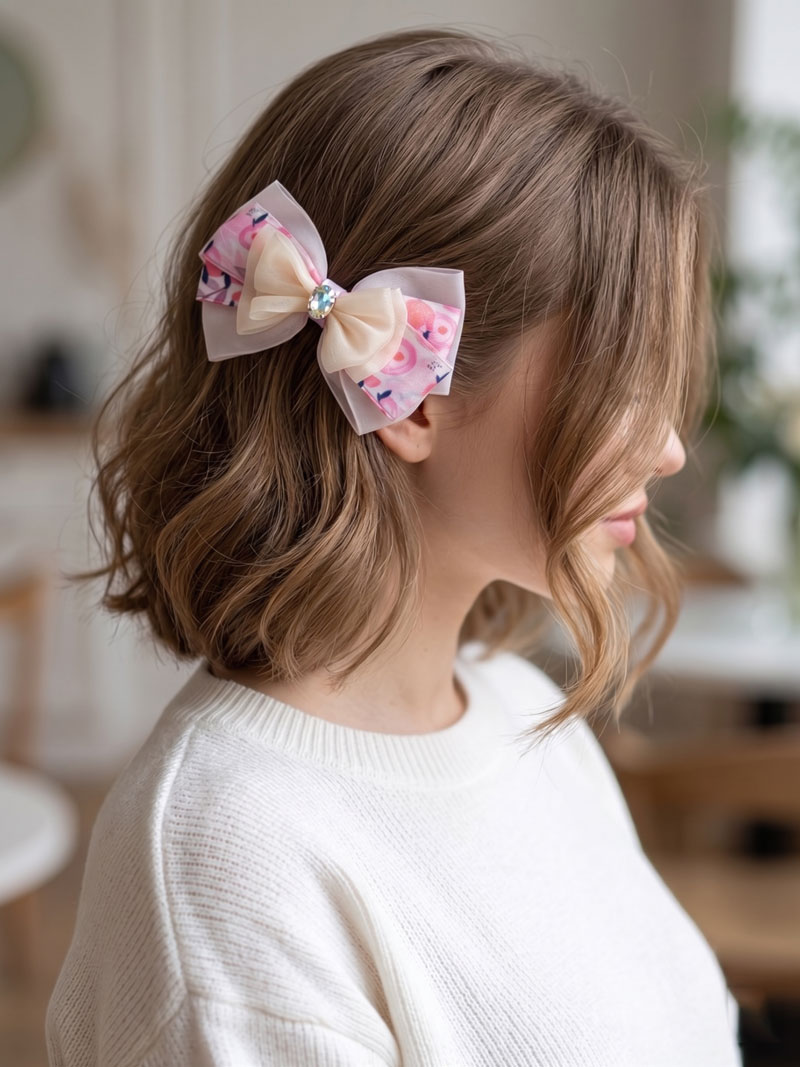
The Rosy Bloom Crystal Organza Bow in the Berkam collection uses organza as the base fabric for exactly these reasons — the crystal embellishments sit on a fabric that holds its form and provides enough structure for the crystals to lay flat and catch light correctly.
When to Reach for Organza
For occasions where structure matters. A formal event, a wedding — any context where you want the bow to maintain its shape through hours of wear and movement. Organza is more reliable in this respect than most alternatives.
When the bow is meant to be a feature. Large, visible, photographically present — organza supports this register better than softer fabrics.
For evening. Organza’s slightly crystalline sheen looks particularly good in interior evening light. It catches warm light differently than grosgrain or matte silk.
When layering is part of the design. If the bow incorporates multiple fabric layers, organza’s sheer body makes the layering visible and interesting rather than just bulky.
Care for Organza
Organza is more delicate than grosgrain but holds up well with appropriate care. Hand wash in cool water with gentle detergent, reshape while damp, and lay flat to dry. Silk organza needs particular care: avoid hot water (which causes shrinkage) and avoid rubbing (which can break the twisted threads that give organza its characteristic texture).
For storage: lay flat, not folded. An organza bow compressed in a drawer will eventually crease, and organza creases are more difficult to remove than those in grosgrain because pressing requires more care (steam works better than direct ironing).
[Explore our organza bow collection →]
Frequently Asked Questions
What is an organza hair bow?
An organza hair bow is a bow made from organza — a plain-weave fabric with a crisp hand and slight sheen, made from silk or polyester. Organza’s combination of sheerness and body allows it to hold dimensional bow shapes without internal support. Unlike soft fabrics (chiffon, silk), organza maintains loop shapes reliably, making it well-suited to larger, more structured bows.
What is the difference between organza and chiffon for hair bows?
Chiffon is soft and fluid — it drapes beautifully and moves well but relaxes into softer shapes over time. Organza is crisper and more structured — it holds the shape set in it and maintains bow loops through movement and extended wear. Chiffon bows look more organic and romantic; organza bows look more architectural and defined.
Can you wash an organza hair bow?
Yes, with care. Hand wash in cool water with a gentle detergent — avoid hot water (which causes shrinkage) and rubbing (which can distort the weave). Reshape while damp and lay flat to dry. Don’t machine wash or wring. For silk organza specifically, use a silk-specific detergent and handle particularly gently.
Is silk organza better than polyester organza for hair accessories?
Silk organza has a warmth and depth to its sheen that polyester doesn’t fully replicate, and it has the natural comfort properties of silk (warm against skin, no static). Polyester organza is less expensive, more dimensionally stable in some conditions, and the visual difference is less apparent in photographs than in person. For most hair accessory applications, a quality polyester organza performs well; silk organza is worth the premium for occasion pieces where the difference will be seen and felt.
How do you store organza hair accessories?
Lay flat, not folded — organza creases under compression, and the creases are more difficult to remove than those in grosgrain. Don’t store under other accessories. For bow shapes, loosely place tissue inside the loops to maintain their form. Keep away from direct light, which degrades both silk and some polyester fibers over time.